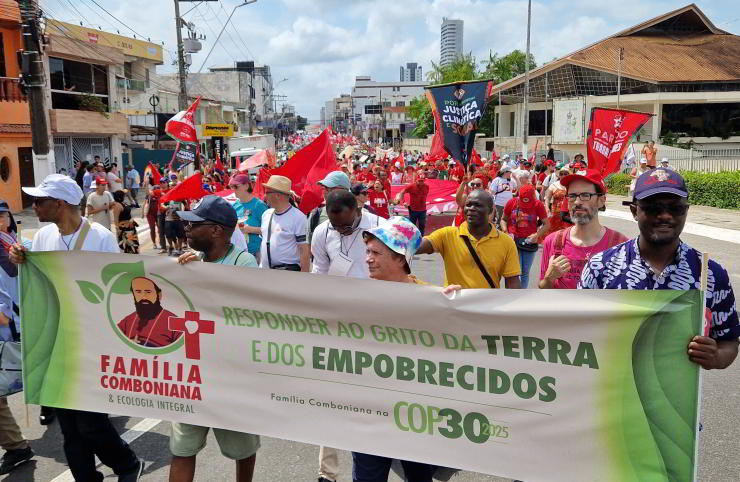
Members of the Comboni Family met in Belém to reflect on the impact of the COP30 sessions. They developed a plan of action for the Comboni Family. Their final message is below.
“We know that the whole creation has been groaning in labour pains until now. And not only that, but we ourselves, who have the first fruits of the Spirit, groan inwardly as we wait eagerly for adoption as sons, the redemption of our bodies” (Romans 8:22).
“There are not two separate crises, one environmental and the other social, but a single and complex socio-environmental crisis” (Laudato Si’, 139). Summoned by the cry of the poor and of the earth, thirty-nine representatives of the Comboni Family gathered in Belém (BR) on the occasion of COP30 to participate in the Forum on Integral Ecology.
From November 11 to 18, we participated in all the meetings and debates organised around COP30, dedicating time to work together, share moments of spirituality, and reflect on what impacted us from what we heard and saw during the COP30 sessions. These were days of encountering and listening to the Spirit present in the struggle of the Amazonian peoples and people all over the world.
We gathered in Belém with the conviction that, at this decisive time, important pages of history are being written alongside the demands and proposals of communities, in support of the multilateralism of peoples, against all denialism, and against the interests of those who prioritize profit over life.
The Amazon, which hosts COP30, is a territory of resistance and inspiration, rooted in the ancestral wisdom and mysticism of its peoples. Listening to them, we become aware of the severe socio-environmental crisis we are facing: a civilizational crisis that requires a profound transformation of our individual and collective lifestyle, of this economy that kills, and also of a Christian spirituality that has separated the Creator from His creatures.
The confluence of waters up to the mouth of the Amazon River has brought together people from all over the world, with a particular emphasis on an increasingly conscious and organized indigenous leadership. It gives us hope to share the life and dreams of these peoples: in Belém we strongly feel the smell of mission!
We feel part of a Church on the move, seeking transformation, allied with ancestral and scientific knowledge, in an ecumenical and interreligious dialogue that opens minds and hearts. We celebrate the lives of many martyrs, who have stood and continue to stand in solidarity with the cries of the Earth and impoverished communities.
We participate in many debates, within the institutional areas of the COP, at the People’s Summit, and in the Interreligious Tapiri, deepening a systemic vision of the environmental and climate emergency we are experiencing. Faith communities, churches, and consecrated life have a unique potential and responsibility to offer a path of hope in this context, and this path is called the spirituality of Integral Ecology!
As people convinced and inspired by the treasure of Comboni charisma and the legacy of the Church’s social doctrine, who revive evangelization as the promotion of the dignity of the person in all its dimensions, we renew our commitment as the Comboni Family and propose the following courses of action:
- Promote and sustain ecological conversion at the personal and community level to transform all relationships based on inequalities and injustices;
- Develop initial and ongoing formation processes on Integral Ecology and cultivate a spirituality that is incarnate, liberating, and founded on networked collaboration, valuing liturgical life in our communities;
- Journey as a Church, valuing ongoing initiatives such as the Laudato Si’ Action Platform, Sowing Hope for the Planet, Creation Time, and Laudato Si’ Week, deepening the Church’s teaching and, particularly, the Call of Churches from the Global South for Climate Justice and our Common Home;
- Map and make visible the practices of the Comboni Family to raise awareness about the scope of our commitment to Integral Ecology, including simple and sober lifestyles;
- Recover the Comboni Covenant for the Common Home;
- Cooperate with the Comboni Family’s media in the missionary commitment to Integral Ecology;
- Include Integral Ecology in popular education and formation within our communities, using methodologies appropriate for different ages and contexts;
- Support political advocacy actions from the territories, with the leadership of the communities, also promoting activities that implement possible alternative economic models, inspired by the Economy of Francesco and Clara;
- Facilitate collaboration among the different branches of the Comboni Family by continuing a General Committee, including promoting an exchange about our practices through formative webinars twice a year.
We thank God and the people who welcomed us and, especially, the coordination that organized the Forum and everyone who made its realization possible. May this seed sown in the soil of the Comboni Family bear fruit of renewed commitment, in response to the urgency of the signs of the times!
Comboni Missionary Sisters; Comboni Missionary Lay Men and Women; Comboni Secular Missionary, Comboni Missionaries of the Heart of Jesus.