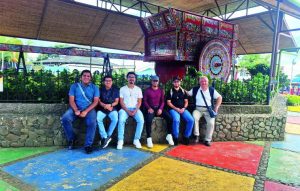
The Africa-Europe Faith and Justice Network (AEFJN) of Cameroon was founded in 2010 by several missionary congregations to promote justice and defend human dignity. We met with them.
The institution’s headquarters are located in the Mvolyé neighbourhood of Yaoundé. We met Sister Geny Maria da Silva, a Brazilian Comboni missionary who has been working with AEFJN since 2019. The AEFJN Cameroon coordination team is made up of five people: two religious and three lay people. In addition to the Comboni Sister, here is another religious Fr. Simon Valdez Ngah, of the Congregation of the Missionaries of the Sacred Hearts, who is the national coordinator of AEFJN. Joël Nomi, for his part, is a lawyer.
AEFJN-Cameroon focuses its work on five key areas, summarised by Father Valdez: preventing drug use and consumption in schools, supporting communities affected by land grabbing, social cohesion programmes for internally displaced persons, especially those affected by the conflict in Ambazonia, projects for the social inclusion of young people with disabilities, and strengthening psychosocial skills among religious men and women.
Father Valdez states, “We are not alone. We are religious, and in every ecclesiastical province we have groups of religious men and women, as well as lay people, who are deeply committed to the pursuit of social justice. They are the ones who help us gather information on the ground and organise our activities.”
In Cameroon, as in many other African countries, populations are increasingly victims of land expropriation. Lawyer Joël Nomi is well-versed in this phenomenon and highlights two types of fraudulent exploitation. On the one hand, there are foreign multinationals that demand land from the state in exchange for large sums of money. In this case, the government bypasses legal proceedings and expropriates people’s land without compensation.
The increase in drug use among young people represents another challenge for AEFJN-Cameroon, which seeks to address it through its drug control platform. “Our awareness-raising work focuses primarily on schools and parishes, where we try to instil good habits among young people,” says Father Valdez.
In these sessions, and in discussions where young people are warned about the dangers of using illicit substances, great importance is given to meetings with teachers, youth workers, and parents. These sessions address topics such as the need to protect young people, identifying the signs of drug use among young people, and steps to help someone quit.
Sister Da Silva says: “In schools, in addition to prevention, AEFJN organises sessions on environmental and ecological issues, because the cry of the earth and the poor is a constant challenge that requires us to value integral ecology, as proposed by Pope Francis in the encyclical Laudato Si’.” Father Valdez adds that AEFJN is pushing “for environmental education to be introduced into the school curriculum and also into pastoral care.”
Another focus of AEFJN-Cameroon’s efforts is related to the armed conflict that, since 2017, has pitted the Cameroonian government against various separatist groups in the two English-speaking regions of western Cameroon. Due to this crisis, more than a million people from Ambazonia have sought refuge in other parts of the country. In some places, the presence of displaced persons is causing serious problems for coexistence.
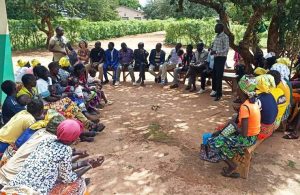
The social cohesion programme for internally displaced people in Cameroon, promoted by AEFJN, includes, as its first action point, the organisation of training sessions for religious leaders presents in the area, so that they can inform and raise awareness and facilitate the reception of displaced people. Specific measures have also been proposed for displaced people in rural areas, allowing them to access land to cultivate without paying rent and, at the end of the year, hand over a portion of their harvest to the landowner, based on their production.
Another critical aspect of these programmes is convincing local authorities of their obligation to ensure the reception of displaced people, so that they can make all the area’s resources, such as health centres and water points, available to them. According to lawyer Nomi, “Local populations also suffer from a lack of resources and must not be the ones who suffer the consequences of the displaced people’s situation. This is why the involvement of local authorities in regulating coexistence is so important.”
Looking to the future, the AEFJN-Cameroon coordination team agrees that financial matters are its primary challenge. “We are very concerned about the lack of funds for the development of our day-to-day activities, especially because we struggle to pay the people who work with us,” says Sister Geny Maria da Silva.
Notwithstanding this, the team is working hard to secure funding, which comes not only from abroad but also from within the country. Father Valdez is requesting that the Ministry of Health support anti-drug courses. The religious says, “The Ministry of Health should be concerned about the increase in drug use among young people, but every time we ask for help to fund our awareness sessions in schools, we never receive a response.” The national coordinator also regrets having to reduce support for communities affected by land grabbing due to a lack of funds to cover travel costs.
Another challenge they highlight is the lack of prophetic voices within the Church. The AEFJN-Cameroon coordination team prepares reports on their observations in the field. It delivers them to the bishops, who must then present them to the public and politicians, as Father Valdez emphasises, implying with a gesture that most prelates do not meet expectations.
We left the headquarters with the conviction of having found a group of committed people endowed with an “active faith,” as Father Simon Valdez likes to say, who are achieving authentic miracles with great simplicity and humility and are true “messengers and builders of hope.” (Enrique Bayo) – (The AEFJN Cameroon coordination team: from left Fr. Simon Valdez Ngah, Sister Geny Maria da Silva and Joël Nomi. Photo: J.L. Silván Sen)