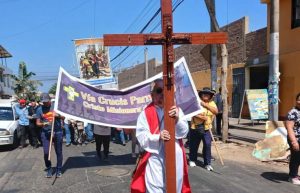
“Sometimes I think the only way to talk about God is to remain silent and offer an embrace full of tenderness and hope,” Father Alessio Geraci, an Italian Comboni Missionary, tells us about his missionary experience on the outskirts of Lima.
I am the parish priest of Cristo Misionero del Padre, in Chorrillos, on the southern outskirts of Lima, which celebrated its 30th anniversary last November. We are three Comboni missionaries who form a community, and for me, it is a blessing to share our lives with the holy and faithful people of God who live in the parish territory, home to more than 100,000 people. We feel we are heirs to a fruitful Comboni tradition, because many missionaries from the congregation have left their mark here.
The parish follows a shared pastoral plan that helps us overcome improvisation, immediacy, and a lack of horizons in our work. Everyone – priests, deacons, men and women religious, and lay people – is involved in a journey of communion and participation with a missionary spirit.
Here we also see the realisation of St. Daniel Comboni’s dream of giving the laity a leading role, ensuring that they are not simply recipients of evangelisation but active participants. Each of the 13 Christian communities that make up the parish has two councils, one financial and one pastoral. I can safely say that they are small parishes within the parish, where we priests are “spiritual advisors” who accompany them.
I feel this is the key to our presence. Accompanying them through joys and sorrows, demonstrating with words and concrete gestures of closeness and tenderness that the God of Life is truly a God with us, a friendly God, a God in whom we can place our trust, because He seeks only our happiness.
The course of the day is marked by attention to the needs of our people: visits to the sick, accompaniment to those experiencing the death of a loved one, or, during important liturgical seasons, visits to schools.
Social action is manifested through concrete works. We have 24 soup kitchens, a parish pharmacy, a physical and occupational therapy centre for children and adults, a school support service for students with limited financial resources, a psychology service, fraternal support for families experiencing extreme poverty, and other activities for adults. Accompanying parish leaders in social work is truly a blessing.
Another key moment of our day is the service in the parish office. People come to confess or simply seek advice or a word of hope. Pastoral workers also come to coordinate activities, as well as people from the institutions with which we collaborate.
We have concluded the Jubilee of Hope, during which we were invited to be pilgrims of hope and to bring it to the neediest corners of our country, to those existential and geographical peripheries so often spoken of by the beloved and remembered Pope Francis.
Peru needs a great deal of hope. We are living in very difficult times, and insecurity in the country may have never been perceived as it is now. It’s an explosive mix. On the one hand, hitmen and extortion make it very dangerous to go out on the streets or take public transportation. On the other hand, there is corruption, even in institutions that are supposed to ensure citizens’ well-being and safety. This is compounded by severe instability and a serious social, economic, and political crisis. People, especially young people, feel a strong sense of oppression, and when they take to the streets to demonstrate their desire for peace, they are repressed by the police.
As the country is divided and polarised, we are pleased to learn that Pope Leo XIV plans to visit Peru this year. The people consider him “one of them” because, although he wasn’t born here, he spent much of his priestly and missionary life bringing the light of the Gospel to the most remote corners of the country. He loves these people so much that he obtained Peruvian citizenship.
Personally, since October, I have been a chaplain of the maximum-security women’s prison. My service consists not only in celebrating the Eucharist or hearing confessions, but above all in listening, consoling, counselling, and reflecting the merciful love of the Father, who “does not treat us according to our sins,” because “he is tenderness and compassion, slow to anger and abounding in love.” Sometimes I realise that the only way to talk about Dias is to remain silent and offer a hug full of tenderness and hope.