We Christians must rekindle hope and shout it loudly to a world that has none.
The Jubilee has ended, but its message should live on and not be lost: the message of hope. Pope Francis, in announcing the Jubilee, gave this instruction: “Pilgrims of hope.” Today, not only has faith grown weak, but even more so hope, because Christians no longer believe in an afterlife, in eternal life; they no longer await the kingdom of God, they no longer invoke Jesus as the coming Lord.
Must we Christians not rekindle hope, relearn its grammar, and shout it loudly to a world that has no hope? In the dark night we are living through, if we did not have hope, even our faith would be fragile and weak. Gone are the days when science and technology promised us a positive prediction of geopolitical, financial, democratic, and healthcare trajectories… We now face the painful experience of impotence in the face of the contingent circumstances of fragile life, assailed by the lust for power and the greed for wealth.
Political action today appears very difficult and confusing: there is widespread distrust, a desire to dominate, and daily aggression. Yes, our world lives in an era characterised by instability and fragmented, disjointed political will. But hope cannot die except with humanity. And as long as there are human beings, there will be resisters capable of hoping against all hope. Many won’t understand, but I remain convinced that to read, understand, and say something about Christian hope, we must do so starting from the Gospel, that is, from Jesus Christ. Yes, because Jesus is hope.
Beyond speaking words of hope, Jesus Christ is hope in himself; more than speaking words of life, he is life! Now, in the Gospels, where Jesus Christ is given to us as the only unveiled image of God, we realise that he, who descended from heaven through the Incarnation and became entirely human, equal to us in every way, never succumbed to the temptation to live by an illusory denial of reality. Indeed, he saw the difficulties the human condition presented him without exception, keeping a door open to the possibility of being surprised by a good event, by a good force that proceeded from God.
Hope is a crack; we don’t always see it, sometimes it remains hidden, but we must believe that it is there and that it is destined to widen, to become a window through which light shines. Wherever there is a man or a woman, hope cannot die, unless it is suicide: first of hope, then of the body! Yet, it would be enough for a hand from above or below to open a glimmer of light that reaches even where there is mortal darkness to give us reasons to continue to breathe.
Between Jews and Christians, then, we should not forget that no one could believe they could cross the Red Sea on dry ground, but when the children of Israel dared to set foot in the sea and walk hand in hand, they found themselves on the other shore and sang the Song of the Sea with joy (cf. Exodus 15). This is why we look to Christ: “Christ in you, your hope” (cf. Colossians 1:27). This is not only a decisive Christological affirmation, but it testifies that Jesus was the hope of those who encountered him in their lives, who listened to him preach the Kingdom. It is enough to refer to his gaze because it is precisely in a person’s gaze that the presence of hope is perceptible.
The eye that hopes is an open eye, ever vigilant, that looks in the sense that it sees, dwelling with awareness, reflecting on things. This is why where he saw a field of ripe wheat, Jesus perceived the image of an approaching eschatological harvest; Where he saw a flock scattered on the hills, he saw his wandering community without shepherds; where others were dazzled by the stones of the temple, Jesus foresaw its destruction; where the solemn pontificals of the temple took place, he saw a poor widow throwing all her possessions into the temple treasury.
Likewise, where priests saw a prostitute, he could see a woman capable of holiness; where religious men saw public sinners, Jesus saw potential disciples, the first admitted to the Kingdom… Another eye, another hope. It is not just clairvoyance, it is hope, a gift from God, it is the Holy Spirit, Jesus’ inseparable companion, who also experienced the kenosis that led him to descend from the Trinity with his Son, among us humans.
How many times does Jesus say to those who come to him, sending them back: “Go, your faith has saved you!” Words that dazzle and transmit hope, where hope in the power of the Holy Spirit remakes a man, a woman, as a new creature. Jesus’ gaze is not only missionary, with the ability to elect and call, but, above all, it is a gaze of mercy, which inspires hope. Jesus becomes the archegos, “the one who shows the way” of hope for all his disciples, and leads them to understand the hope of hopes, the Resurrection!
Hope can make possible that which seems impossible to men. In times of anguish and desolation, when we have been slandered and rejected by all, when friends have distanced themselves, and it seems we have been delivered to destruction by our closest companions, perhaps by those who betrayed us, the faithful companion who shared our bread at our table, we can protest to God to the point of hurling invectives against him.
We see his face as that of an enemy, who does not look at us, who casts us into darkness, who attacks us like a bear… Why, Lord? Where are you? Those who pray like this construct a perverse image of God’s face and justify their weeping and protesting. But precisely because “it is good to wait in silence for the Lord’s answer,” we must instead learn to wait patiently, because God will intervene. All those who pray and have experienced the tribulation of God’s absence say as much.
Little by little, they understand that it was not God who was silent, but they themselves who were deaf to his Word. And they learn that God speaks in silence and that in silence he is closer than ever! During the ascent to Jerusalem, Jesus three times announced to his disciples the necessity of his passion and death, events closely linked to the Resurrection, to the intervention of the Father, who will call his beloved Son from the dead: “The Son of Man must suffer many things, be crucified, and on the third day be raised!” The disciples felt this hope surfacing on Jesus’ lips, but, they did not yet understand: “What does it mean to rise from the dead?” (cf. Mk 9:10).
But with the dawn of the third day, the Easter proclamation resounds for the women disciples, and from then on, hope triumphs in a song parallel to the Canticle of the Sea: “Christ is truly risen, and has appeared to Simon!” (Lk 24:34). Christ appears to be the one and only hope of the disciples and of the entire cosmos. He is the source of our hope, which, in its extreme impotence, is the hope of the resurrection from the dead.
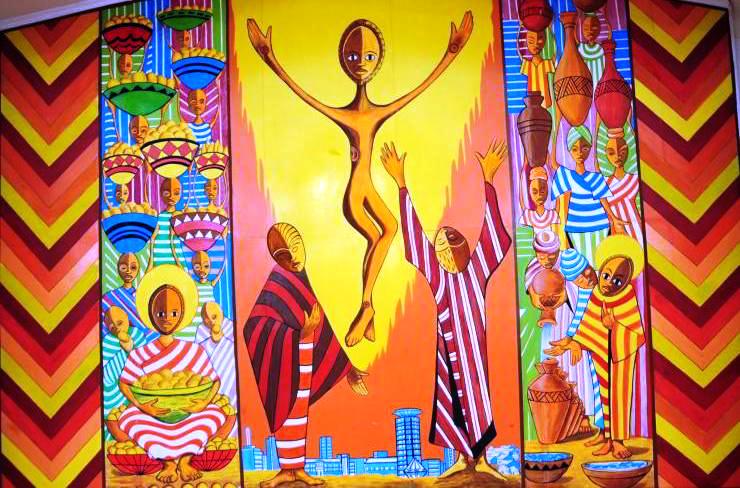
If Christ is risen from the dead, we will all rise again after him. This is Christian hope: death will be conquered, the Kingdom will be opened, we will dwell in the heavenly Jerusalem in the communion of saints, and God will be all in all! This hope is the Christian difference from other men: communicating hope to them certainly means communicating that the love they experience conquers death; they must always be aware of this. This seems to me to be the only obligation, the only message we can offer, if they accept it, to non-Christians. And we offer it not only by proclaiming love but by loving concretely. We dare so little to love! So little that love is not credible and therefore incapable of conquering death. But hope is the gift of the Holy Spirit. (Painting by Father Engelbert Mveng, Cameroonian Jesuit) – (Enzo Bianchi)