From Saharan myth to crossroads of migrants and gold miners: history, crisis, and uncertainties of the Tuareg capital of Niger, between memory and future.
Gateway to the desert, city of the blue people, crossroads of trans-Saharan trade… Whatever you call it, the city of Agadez, a dusty urban agglomeration in the heart of Niger, about 900 kilometres from the capital, Niamey, has long held a central place in the history of the Sahel-Saharan region.
Its centrality is inherent in the name’s etymology, which derives from egdez, meaning “place of visit” in Tamasheq, the language of the Tuareg people, who first settled there and are therefore considered its founders.
Since its origins, which appear to date back to the 14th-15th centuries, Agadez has been a meeting place for the various local communities and a transit point for caravans that, travelling from the kingdoms of West Africa, passed through it laden with salt, gold, ivory, and slaves on their way to the markets of North Africa and the Mediterranean coast.
From there, they returned, bringing back manufactured goods and grains. Agadez was the true hub of this coming and going, thanks to its geographical location: strategically placed equidistant between the various commercial and cultural hubs of the ancient African world.
In more recent times, the comings and goings of caravans have given way to other, equally lucrative, types of trade, and Agadez has transformed from a transit point for valuable goods into a veritable “logistics hub” for tens of thousands of migrants who, departing from the Sahel and sub-Saharan Africa, converge here to embark on the “journey of hope” toward Europe through the desert, Libya, and the Mediterranean Sea, on what is considered the principal and most dangerous of contemporary migration routes.
This significant influx has profoundly affected the city, influencing not only its demographics and urban planning but also its economy. Furthermore, from the 1980s to the early 2000s, Agadez experienced a significant tourist boom, and, owing to its strategic location, it became one of the most sought-after destinations for thousands of Saharan travellers.
When yet another Tuareg uprising broke out in 2007, prompting then-President Mamadou Tandja to send the army north to quell the rebels, tourism suffered a drastic setback, further isolating Agadez from the outside world and depriving its inhabitants of what was undoubtedly the region’s main economic resource at the time.
The internal crisis of the early 2000s was indeed complicated by a series of regional developments, primarily in northern Mali, where in 2012 a new Tuareg rebellion, supported by thousands of fighters in the pay of Muammar Gaddafi who had returned literally with their “arms and baggage” after the fall of the Libyan regime in 2011, paved the way for a plethora of jihadist groups – Ansar Eddine, AQIM, MUJAO, etc. – to seize control of the territory.
The repercussions of the war between the Bamako government and Tuareg rebels searching for gold with a metal detector in the Ténéré desert. As a result, in recent years, thousands of residents of Agadez who abandoned the city in pursuit of the mirage of wealth hidden beneath the sand — which also saw the involvement of the French army and a UN force, MINUSMA—have spread beyond the border, destabilizing the entire border region between Mali, Niger, and Burkina Faso with kidnappings of foreign citizens and terrorist attacks against local populations, and fuelling widespread banditry and smuggling of all kinds.
To the south, Boko Haram is putting Niger’s security at risk, where, since February 2015, there has been a series of repeated cross-border attacks by the jihadist group and militia infiltrations in the Zinder area. The deterioration in security has triggered a domino effect, generating instability and unprecedented migration flows.
Migration has profoundly changed the demographics of Agadez, where the population doubled between 2012 and 2022. “According to population growth projections, Agadez was expected to have 16,000 inhabitants in 2022, but instead there were more than 300,000,” says former mayor Tourawa. Following the crackdown on migrants and traffickers by President Mohamed Bazoum, ousted in a coup in July 2023, and the massive European Union funding to stem the flow, today’s migration “is mostly internal and involves Nigerien citizens living in regions where the security situation is difficult and who move to Agadez in search of greater stability, including economic stability,” Tourawa explains.
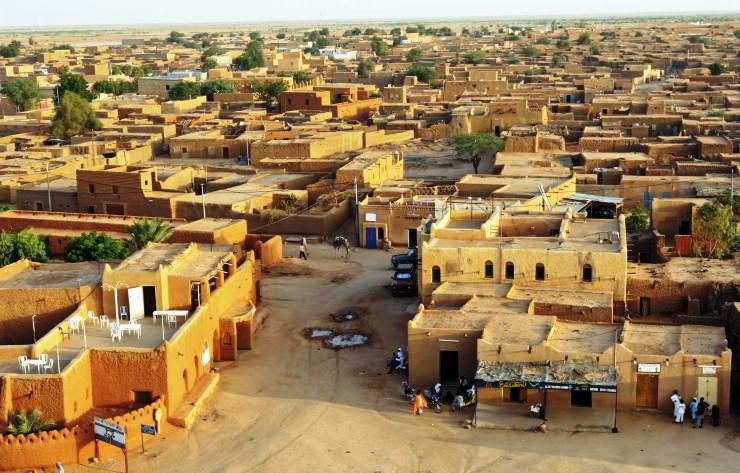
The population boom is also profoundly impacting the architectural face of Agadez, where the traditional mixed clay buildings—known as banco—that characterise the historic centre, of which the great Sudanese-style mosque dating back to the early 16th century is a spectacular example, are giving way to concrete houses, a phenomenon that threatens the very identity of the city.
As Tourawa points out, “Agadez is the only UNESCO World Heritage city in Niger, but for it to continue fulfilling its cultural and historical role, it needs support and investment; Agadez today needs help to maintain its resilience.” Climate change is also contributing to overbuilding: in recent years, the rainy season, which runs from June to September, has become increasingly severe, necessitating more frequent and extensive maintenance of the banco buildings. “Agadez is threatened by degradation due to erosion from extremely aggressive rainfall, so the city’s protection system will need to be rethought,” the former mayor adds.
Migration is just one of the factors that have led to the profound demographic and urban changes seen in Agadez over the last decade. Another decisive factor was the 2014 discovery of major gold mines in the north of the country, which attracted many young people and adults seeking a bit of fortune, however fleeting.
“Gold is not a guarantee: there are those who sell everything to go looking for gold, but then don’t find it, or find it but remain in debt, unable to recoup their investment,” explains guide Ibrahim. “Of course, there are also those who have made a lot of money with gold, but it’s almost a monopoly.
“At the same time, however, this discovery has been a blessing for the Agadez region, because it has deterred many from engaging in illicit trafficking,” Ibrahim observes, convinced, however, that gold will not restore Agadez to its former glory: “I believe in tourism and sustainable agriculture as ways out of the poverty we find ourselves in, but there will be no future for Agadez without peace.”
Tourawa agrees. “Tourism is vital because when we talk about population resilience, we’re talking about cultural, artisanal, and historical potential,” he explains, emphasizing how the city of Agadez sits “between tradition and modernity, it’s a strategic city, it’s the umbilical cord between sub-Saharan Africa and North Africa, it’s a crossroads that continues to evolve and grow while remaining an epicentre and a point of reference for Africa and the Sahel in terms of tradition and culture, and for its geostrategic position.”
But for this city to continue to play its role and exert its allure in the imagination of so many tourists, the former mayor confirms, “it is necessary to rediscover peace.” If yesterday Agadez was the city of imagination and hospitality, today it is the city of resilience, the Agadez of tomorrow, the one its inhabitants hope to build. It is therefore a city “at peace” and “of peace,” where all its ethnic groups, with their languages and traditions, can coexist and collaborate in the common interest, as they have done for centuries.
Agadez’s history is certainly not without conflict and crisis, from which, however, the city has always recovered thanks to its ability to adapt, the synergy between its internal forces, and its openness to the outside world. “We are facing various crises, but we must fight to safeguard everything we are,” is Tourawa’s firm resolve. This urban centre, located in northern Niger, on the slopes of the Aïr Massif and bordered by the sands of the Ténéré, still preserves its historical vocation as a place of encounter and welcome and is wondering about its future, however uncertain and full of challenges. (Paola Pizzi/Africa) – (Photo: View of Agadez. File swm)