Our journey into the world of traditional African textiles continues. Today, we take you to Uganda to discover one of the continent’s oldest textiles: barkcloth, which has been a UNESCO Intangible Cultural Heritage of Humanity since 2008.
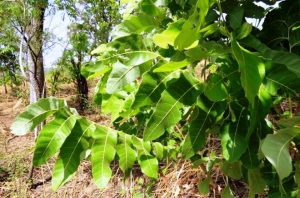
Made from the bark of the Mutuba tree, a plant common in Uganda and southern Africa, the cloth is hand-worked and dyed in shades of brown and red. Traditionally, Ngonge artisans, led by a kaboggoza, the hereditary chief craftsman, made bark cloth for the Baganda royal family and the rest of the community. Its production draws on one of the oldest human skills. Bark cloth is the fruit of a prehistoric technique that predates the invention of weaving.
According to the traditional process passed down through the generations by the Baganda people, the bark is first harvested during the wet season, stripping the outermost layer from each tree.
This is then hand-beaten to create a uniform fabric. It is a meticulous and fascinating process in which every detail contributes to the final result. The bark must not dry too quickly, which is why the artisans usually work under an open roof.
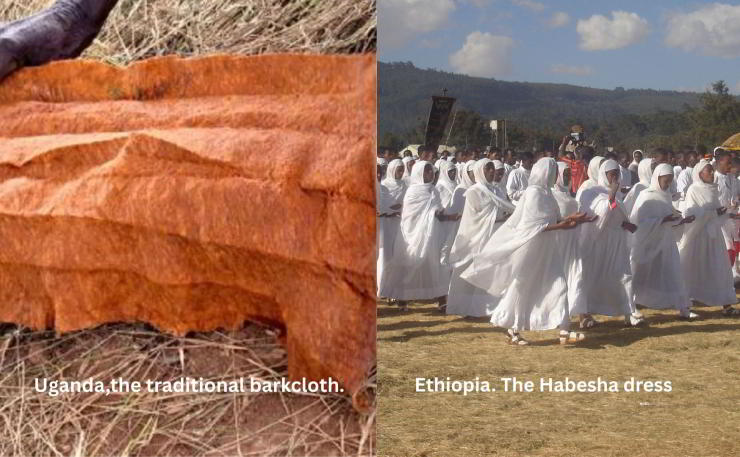
This textured cloth is worn as a toga by both sexes, but women add a sash around their waist. It’s commonly terracotta-coloured, while the one worn by kings and chiefs is dyed white or black to emphasise their social status.
Although the spread of cotton in the nineteenth century diminished attention to this fabric, bark cloth has never truly lost its fame, thanks in part to its sustainability. A few tools and renewable resources are the basis of its production. The bark regenerates in nine months, and the trees live up to 40 years.
It’s also about social, not just environmental, sustainability: its production directly involves rural communities, especially women. The cloth is used primarily during coronation and healing ceremonies, funerals, and cultural gatherings, but also for curtains, mosquito nets, bedding, and storage.
The Habesha dress is the jewel in the crown of Ethiopian textile tradition
Discovering the famous Habesha Kemis, a long dress traditionally worn by Ethiopian women during ceremonies and special occasions.
Typically made of chiffon or cotton, the Habesha dress is among the most iconic traditional dresses on the continent. It can be found in various light shades, such as beige, white, or hints of grey. Along with the Habesha Kemis, worn at important ceremonies, Ethiopian women also wear a shawl called a netela.
The Habesha dress is handmade and has been on the market for centuries not only in Ethiopia, but also in Eritrea. A typical occasion when it is worn is the Ethiopian New Year, Enkutatash, which also celebrates the end of the rainy season.
The peak season for Habesha dresses, however, is Timkat, which is celebrated in January. Timkat is the most cherished holiday of the Ethiopian Orthodox Church, with streams of pilgrims flocking from every village in the highland to pray in the stone churches of Lalibela.
The creation of the Habesha dress follows ancient traditional techniques. First, the cotton is spun by the Dewari. It then goes to a Shemane (weaver), who makes the traditional garments. Finally, the finishing touches are made by hand-stitching colourful decorative motifs. A garment takes about 20-25 days to make.