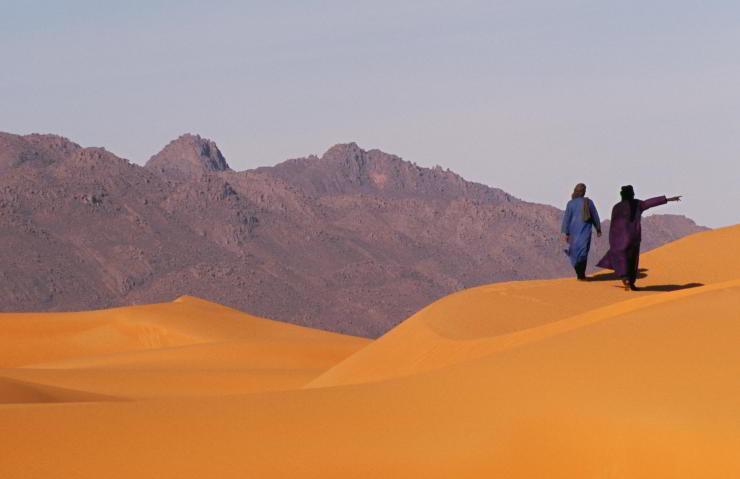
Amid golden dunes, rock carvings, and salt lakes, journey into the heart of the Libyan Sahara: a “window to the soul.” The heart of Libya’s desert, the Fezzan, preserves breathtaking landscapes and ancient traces of lost civilisations. A fascinating voyage through golden dunes, rock carvings, and salt lakes.
Dunes of fine yellow sand and black sandstone, salt lakes, and rock carvings. The Fezzan is the purest desert heart of Libya, a surreal, almost mystical environment that evokes intense emotions and allows for a direct encounter with nature at its most powerful.
Libya’s third-largest historical region, along with Tripolitania and Cyrenaica, the Fezzan represents the Libyan portion of the Sahara, which, beyond its political borders, becomes the Tassili Ajjer in Algeria, the Ténéré in Niger, the Tibesti in Chad, and the Great Sand Sea in Egypt to the west, south, and east, respectively.
A region surrounded by such vast desert expanses that it is one of the most spectacular in the Sahara. This is also because, to the north, more than a thousand kilometres separate it from Tripoli and the Mediterranean. A thousand kilometres of Hamada el-Hamra, a flat, fiery plateau that in the past has tested even the most stubborn travellers and further isolated Fezzan and its natural beauty.
Herodotus wrote of old: “Phezania [the Fezzan] was populated by warlike Berber tribes, the strongest and most numerous of which was the Garamante gens.” Described as “indomitable” by Tacitus, they lived in the oasis of Garama (Germa) and were famous for crossing the desert aboard swift horse-drawn chariots. In 19 BC, the Romans, led by proconsul Lucius Cornelius Balbus Minor and commanding twenty thousand men, launched a punitive expedition and conquered the feared capital of the Garamantes.
The Romans maintained dominion over the Fezzan for approximately four centuries, after which they were supplanted by the Arabs, Turks, and Italians (in 1913). A troubled history of constant battles and domination, well told in the ruins of ancient Germa. Roman temples emerge from ksours, Berber fortifications, rails and small wagons, used in 1935 by Italian archaeologists searching for Roman remains, plying the paved streets.
A blend of forms and styles that dominates the Ajal Valley (the Valley of Life) from a hilltop: in the background, the gigantic dunes of Erg Murzug and Erg Ubari and the black cliffs of Messak Settafet and Messak Mellet.
The wonders of the Fezzan are being discovered day after day: the rock carvings in Messak Settafet, the dunes of Erg Ubari, the Mandara Lakes, the Acacus Mountains. Thus, one finds oneself walking along the bed of the fossil river Mathendusc, admiring dozens of rock carvings. There are more than 500 sites in this area, with approximately 50,000 engravings dating back 10,000 years.
It is an immense open-air gallery of prehistoric art. Elephants, ostriches, giraffes, oxen, panthers, hunters, shepherds, and the famous Mammon Cats, two gigantic felines carved into a rock about one hundred meters above sea level, parade before your eyes. The features are so perfect that you can almost imagine the immense, fertile prairie where humans and animals once lived. The desert arrived here “only” four thousand years ago. Before that, there were grass, rivers, and lush green trees.
Then it’s the turn of the dunes. Towering, sometimes more than 350 meters, they create a sea of curves and sensuality, simultaneously confused and orderly.
The Erg Ubari extends north for more than 500 kilometres. It is a labyrinth of fine, ochre-coloured sand: it takes five days to cross it. Tuareg drivers are masters of the wheel, the only ones who don’t constantly get stuck in the sand and turn the erg into a roller coaster. They speed around dunes, climb impossible slopes, and launch themselves headlong from dizzying heights.
And after all that sand, the Mandara Lakes: a mirage in this arid and thirsty universe. Pools of crystal-clear water – there are 21 in all – created by natural springs, so salty they keep the body afloat, like the Dead Sea. Tiny, nestled between dunes, fringed with date palms and tamarisks, they are the ancestral homeland of the Dawada, an indigenous people.
They lived in the villages of Trouna, Mandara, and Gabr’Aoun, but, on Gaddafi’s orders, they were forced to move to modern centres of glass and brick, abandoning not only their homes but also their centuries-old traditions.
The Dawada have a strange history: for almost two thousand years, they survived invasions and raids by Romans, Arabs, Turks, Tuaregs, Italians, and French, only to succumb to the Colonel. Strange, it was precisely because of their poor, basic, yet free lifestyle, that Gaddafi himself elevated them to a national model in 1973: a dignified example of a life of hardship and sacrifice, contrasting with the idle habits of their urbanised compatriots, slaves to consumerism and Western myths. Perhaps the Libyan dictator felt threatened by their extreme freedom rather than by the Dawada’s extreme poverty.
And to think that it was the Arabs who first scornfully dubbed them “worm eaters,” because they ate dùd, or worms. In reality, they aren’t actually worms, but tiny, edible larvae, similar to reddish crustaceans (Artemia salina), that live in the salt lakes of Erg Ubari. Perhaps they, the Dawada, dark-skinned and short, are the descendants of an indigenous population of Fezzan. Or perhaps they are the heirs of those prehistoric populations who, just a few kilometres away, when this corner of the Sahara was a savannah rich in water, plants, and animals, immortalised their lives on the rocks of Tassili and Messak in the graffiti we admire today. Or perhaps, again, they are the children of the legendary Garamantes of Roman memory.
While the origins of the Dawada remain uncertain, their traditions and rituals are well-established and age-old. They had a mythological ancestor, the old Aoun, buried in the sands of the great dune overlooking one of the most beautiful lakes in the erg, Gabr’Aoun (Tomb of Aoun). Their daily life was fraught with taboos and superstitions. Thus, only women born into the tribe had the right to fish for the worms that provided the basis of their diet.
Equipped with a landing net with a long, very fine mesh, they slowly waded through the silt, collecting the crustaceans along with a seaweed called danga, from which they were inseparable. The mixture thus formed a brown paste, which, after being washed and kneaded, was formed into loaves. Dried in the sun for several days, they were then buried under the sand. After a few months, that black, fishy-smelling paste was ready to be eaten, with a spicy sauce or mixed with crushed dates. A food, according to the scientists who analysed it, with a high protein content.
And while the women took care of the fishing, the men took care of the other profitable activity: the harvesting of natron, a mixture of natural sodium carbonate with other sodium salts. Simply put, the precious, indispensable salt, sodium carbonate, forms through evaporation on the surface of lake water and, especially in summer, settles on the shores, forming a whitish crust.
Too poor to own camels, guarantee transportation, and sell their products, the Dawada were completely dependent on caravan traders that, once a year, would come to these isolated dunes to buy salt for a paltry price, transporting it to Tripoli, Algiers, and Tunis. Natron was mixed with tobacco, used for snuff or chewing and in the manufacture of tanning products. It shortened meat-cooking time and was fed to camels, horses, and donkeys to fatten them. It was also an essential element of the indigenous pharmacopoeia.
Finally, the Acacus Mountains, a stone labyrinth – 30 kilometres wide and 150 kilometres long – where fossil rivers have transformed into intricate paths and where the mountains have crumbled into rock sprites, pinnacles, arches, tunnels, and caves. The cause of all this is the wind, that capricious and treacherous ghibli that, especially in January and February, blows violently and destructively, relentlessly enveloping both men and animals.
The Acacus Mountains are one of the most magical areas of the Sahara, where you can lose yourself aimlessly, letting your gaze wander beyond the next dune, around the next bend. The only appointment to keep is the sunset: to be admired, alone or in company, sitting on a boulder or lying on a dune. An indescribable spectacle of colours and shapes. It’s no coincidence that the Tuareg call this special moment “a window into the soul”: that of men and that of the gods. (Fausta Filbier/Africa)