Cameroon has a long tradition of making textiles from tree bark, from the most well-known fibre, raffia, which comes from a variety of palm trees and is used in making baskets and bags, to the more complex “Obom” fibre.
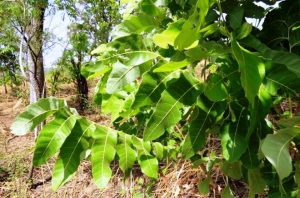
Obom, in the Cameroonian Fang-Beti language, means “fabric made from the bark of the Aloa tree.” The Aloa tree, a soft, white wood, is widespread in the equatorial forest, particularly in Cameroon. Its bark has been the basis for the production of many fabrics and garments for generations.
To this day, ancient processes are still used, a tradition passed down from generation to generation. According to tradition, the process begins with the bark being divided into sheets, which are beaten and steamed. The sheets are approximately 1-2 millimetres thick.
The high quality of the resulting fibre has made Obom, a natural, high-quality fibre, the preferred fabric for the canvases of many Cameroonian artists. Many Cameroonian painters have chosen Obom canvases as the basis for their works.
Maintaining the traditional method is related to the preservation of the cultural identity of peoples, which is also inherent in this fabric and the way it is made.
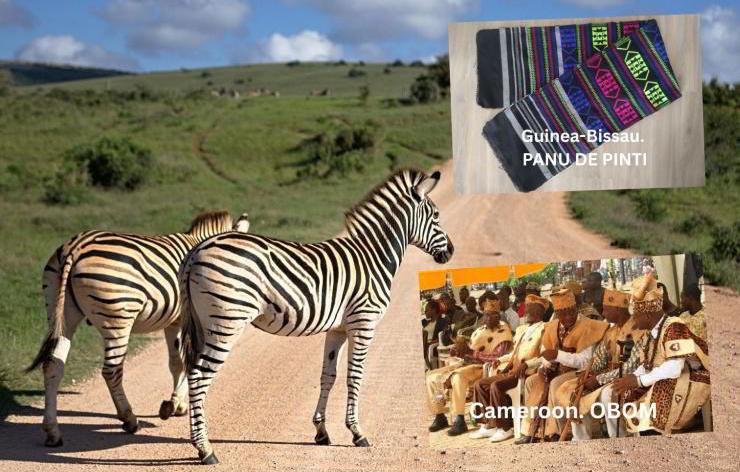
Obom has been used to produce various garments, but it has gained popularity and variety as the garment worn during special and official functions.
Guinea-Bissau. Panu de Pinti is a symbol of national identity.
Our journey to discover traditional African textiles continues. Today, we take you to Guinea-Bissau, home of the “Panu de Pinti” (loom cloth, in Creole), a symbol of national identity and unity for the country.
Panu de Pinti is a symbol of national and cultural identity for Guinea-Bissau, for its ability to unify the multiple ethnic groups and geographical areas that comprise this small country located in West Africa.
The fabric is composed of long strips of cotton, carefully woven together by women on a traditional loom to form a larger cloth. The result is a weave of geometric patterns and bright colours. A single cloth can reach several meters in length.
Panu de Pinti plays a prominent role in social and ritual life: it is used in wedding ceremonies, initiations, funerals, and other symbolic moments in community life. This fabric also represents social status: owning or offering a panu as a gift is considered an honour.
In recent times, the panu has been rediscovered and placed at the centre of local fashion and craft initiatives, adapting it as a stylistic element. On April 10, 2025, the African Intellectual Property Organisation (OAPI) officially registered the Panu de Pinti as a cultural heritage of Guinea-Bissau, with design protection. This recognition is a significant milestone that highlights the fabric’s economic, cultural, and commercial role in local development.
The tradition of panu has stood the test of time, passed down from generation to generation. The Panu de Pinti fabric is increasingly seen as a symbol of craftsmanship, culture, and unity, calling for “weaving a shared global vision for a flourishing humanity.” (Photo: CC BY-SA 4.0/Sfs90)