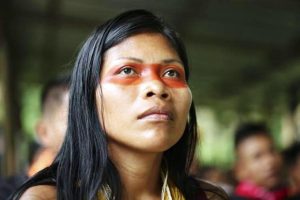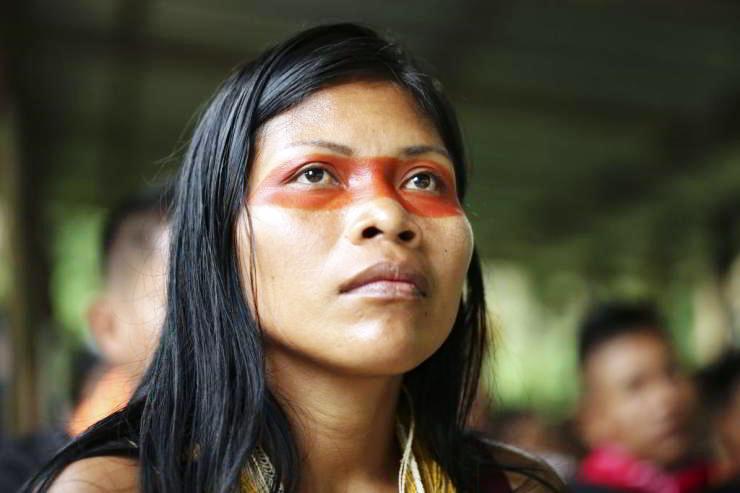
The Waorani activist and leader halted drilling operations in the Amazon and now issues a call to the world: “An awakening of consciousness can guide us to the way out.”
“Our territory is not for sale. And when we say no, it means no.” Glossy black hair, large eyes framed by red henna, a voice both firm and gentle. Seven years after the battle that thrust her into the global spotlight, Nemo – or “the star,” as her name translates in the language of her people, the Waorani – continues the fight for life: for the Indigenous people of the Amazon and for humanity itself.
To this end, in 2012, Nemonte Nenquimo mobilised her community to oppose oil extraction in Ecuador’s Pastaza region. She combined protests with legal challenges. Then, on April 26, 2019, she secured a formal court-ordered halt to drilling operations – a historic and unprecedented ruling. “It was tough; we had to travel all the way to Quito, into a completely different environment. It wasn’t easy to avoid giving in to despair and turning back. But we succeeded.”
With that same strength, she now calls on the world to follow suit and begin the energy transition away from fossil fuels – a commitment the international community made at the 2023 UN Climate Change Conference in Dubai but has since failed to honour. The crisis in the Strait of Hormuz has underscored the urgency of this shift perhaps more than ever before.
“The fact is, escaping the trap of this social and political model – built on the reckless exploitation of resources and consumerism – requires, above all, a ‘spiritual revolution.’ Only an awakening of consciousness can lead us to a way out,” says the 41-year-old activist.
“We do not need to save Mother Earth; it is the other way around. She gives us life, oxygen, and nourishment. Our task is to respect her. It takes effort, resilience, hope, and intuition to avoid losing heart and to keep demonstrating the profound connection between human beings and nature.”
“We cannot exist without one another. Everyone – city dwellers, government officials, and oil industry owners alike – suffers the effects of global warming. Only when we truly grasp this, in both mind and heart, will we change our actions. The first step is to cultivate our inner lives and our connection to Mother Earth.”
Reflecting on her journey of activism, she says: “The hardest and most important task is building community – weaving bonds between the young, the elderly, and children; between women and men. Together. Only in this way can we take charge of our own history, rather than waiting for the government to impose measures or dictate what we must do. First colonialism, and now neoliberalism, have done everything they could to divide us.”
“As a leader, I have sought to draw inspiration from the style of our ancestors, who devoted so much time to listening. Collective decisions – the only kind that truly endure – arise solely from sincere and attentive dialogue. We see this in our own territory, too: through cooperation, we are successfully implementing projects for solar energy production, rainwater harvesting, and forest monitoring.”
Nemonte continues: “I have faith in young people, in civil society, and in Indigenous peoples. I have faith in the women who share a special bond with the rainforest. Mother Earth is feminine energy. She is, after all, a mother. That is why women feel the impact of environmental devastation so acutely; they sense the imbalance deep within.”
What is the message the women of the Amazon have for the world? The environmental leader says: “It is the message we learned from Mother Earth – walking through the forest, bathing in the great river, gazing at the sky, and watching the stars. The only way to live is by sharing, empathising, and collaborating. Our ancestors wept and laughed together, danced to the same rhythm, and helped one another. We must reclaim this ancestral wisdom before it is too late. We are wandering irresponsibly on the edge of the abyss. But we haven’t fallen in yet. We can still make it.” (L.C.) – (Photo: Goldman Environmental Prize/Jeronimo-Zuniga)