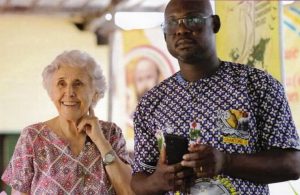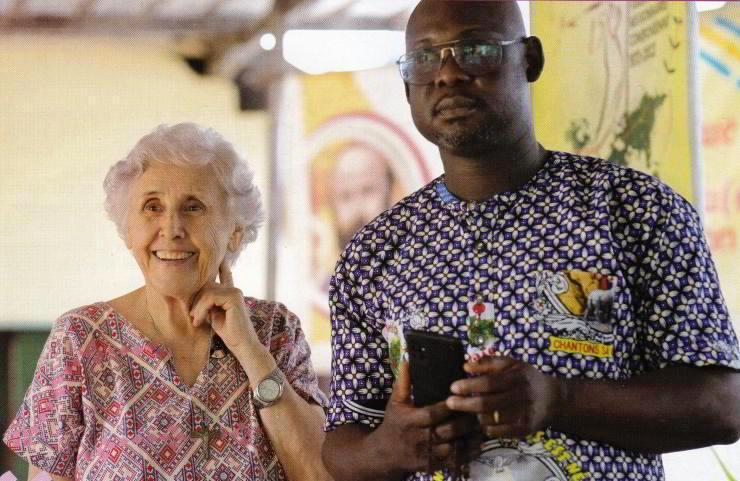
Sister Magdalena Ribas, a Comboni missionary, has spent more than fifty years in Africa – in Chad and Togo – facing wars, illness, and suffering, while also experiencing many encounters that have brought her great joy. She herself says: “The mission is wonderful: proclaiming the Gospel, bearing witness, and always opening the door to those who knock.”
At only nine, she first encountered a question that would change her life. “I was born in Santa Margarita, a small village in the north of Mallorca, and ours was a practising Catholic Christian family,” she recalls. In those days, ‘popular missions’ were organised: missionaries would arrive and spend a week in the village to evangelise.
I attended the Augustinian school, and during one of these gatherings, they asked if any of us would like to join them on a mission. None of us responded, though we were all quite taken aback. Once we got home, a friend and I decided to go and see those priests. We told them, ‘Father, we want to come with you.’ He replied that we would need to eat plenty and grow a bit more if we wanted to take part. I was just a child, but I believe that was the first time I felt the desire to dedicate my life to those distant lands.”
However, it was the killing of a Dominican nun in the Congo that convinced Magdalena this might be her path. “We had moved to the city, and for a while, I had forgotten that desire—but then something happened that reawakened it. A Dominican missionary had been murdered in the Congo, and during her funeral, the priest asked, ‘Who among you will go and take her place?’ That question stayed with me.
I was about 15 at the time, and I asked myself: Who will proclaim the Gospel to those people? Through my involvement with the church and the nuns, everything began to take shape. I decided that I wanted to become a missionary and, specifically, that I wanted to work with lepers.” Magdalena went on to study nursing. “For me, my primary vocation was medical care. I wanted to be of service to the poorest and most needy, and I believed the sick best fitted that description. And among them all, I believed that those suffering from leprosy were in the greatest need.”
She decided to join the Comboni Missionary Sisters and, at 25, left for Chad. Upon her arrival, however, she realised that in Africa there were other forms of “leprosy”—conditions just as serious, if not more so: ignorance, a lack of healthcare, schools, means of transport, and freedom of choice. Faced with so many deficiencies, where does one even begin? Magdalena continues: “We arrived at a mission that the Jesuits were just then leaving, and where there was no healthcare whatsoever.
They told us, ‘Spend the first year observing; visit the villages and ask the people what they need—then you can see what you might be able to do.’ There were four of us, and we divided the work among ourselves: pastoral care, schools, the development of women, and healthcare. I chose the rural healthcare project—specifically maternal and child health—focusing on prevention and vaccinations.
I had been so deeply struck by cases of tetanus that I decided to dedicate a great deal of time to vaccinating girls of childbearing age and mothers, to prevent their children from falling ill. We also conducted prenatal check-ups and monitored the women’s health. If we noticed potential complications, we would transfer them to a hospital; we essentially acted as an ‘ambulance’ to transport them. There were two hospitals—one 64 kilometres away, and the other about 100 kilometres away. Moreover, there was a war in progress.”
We asked her if she was ever afraid. Sister Magdalena replied: “I look back on those first fifteen years with great affection; in the beginning, there wasn’t much that frightened me, even though those were years of war. In March 1979, there was a coup d’état—that, indeed, was frightening. I had never witnessed a war or a coup d’état from such close quarters. It is one thing to hear about reprisals taking place hundreds of kilometres away, but quite another to have them occur in your own country—right where you happen to be. During the war, we had to organise many things: districts, dispensaries, primary healthcare centres…”
In 2012, she left Chad and moved to Lomé, on the outskirts of the capital of Togo. Sister Magdalena describes her new experience: “It’s different from Chad, because here I live in a city. My work is different, too: I help the sick, the poor, the homeless, and those who lack the means to get by. I support families and do my part to ensure their children receive an education by promoting projects and raising funds.”
“If a child starts school at the right age and completes their education, they can move forward. But if they are sent home for a month because their parents cannot afford the fees, they often struggle to catch up or reintegrate once they return, having missed so many lessons. The school dropout rate is high. Working with the most disadvantaged—people who have nothing with which to repay me—is deeply rewarding. It is what Jesus did, and that brings me joy.”
At 77, Sister Magdalena continues her mission in Togo. “I am slower now; things take more time, and I can no longer run around. I don’t make long-term plans. In Africa, I’ve learned that ‘time’ as a concept doesn’t really exist, and that life is experienced differently. There are moments of doubt and discouragement, but also of enthusiasm and hope. Sometimes you need patience and understanding—approaching things with peace and love, rather than impatience.”
We ask her, “What does ‘mission’ mean to you?” “The Lord has called you to something. If you can fulfil that, your mission has meaning. It is important to find your place in the world; without it, something is missing. We are meant to solve this mystery, but we often fail to hear what God is telling us because we are distracted. Mission is a wonderful thing: proclaiming the Gospel, serving as a witness, and always keeping the door open to those who knock,” Sister Magdalena concludes.