It is one of Southeast Asia’s youngest nations. Its vast potential seeks avenues for development that the single-party regime – in power since 1975 – struggles to open up. Freedom of worship is guaranteed, yet state control is pervasive. The small Laotian Church operates discreetly.
With a population of 7.8 million – half of whom are under the age of 30 – Laos boasts one of the youngest populations in the region. This demographic structure represents an asset: every year, millions of young people enter the labour market, while the country – governed by a regime isolated on the international stage – seeks to modernize its economy and strengthen regional integration.
Since 1975, Laos has been governed by the Lao People’s Revolutionary Party, the successor to the communist Pathet Lao movement that fought a civil war against the monarchy. The communist regime severely restricted individual freedoms, and the economy performed disastrously, with over 10% of the population leaving the country.
It was only between 1986 and 1990, through the “New Economic Mechanism” reforms, that the country opened up to foreign investment, following Vietnamese and Soviet models. Nevertheless, the Party remained the sole holder of power.
In 1991, Laos adopted its first official constitution, which consolidated the Party’s power while simultaneously legalizing private property and guaranteeing religious freedom. That same year, following the dissolution of the Soviet Union, the country began diversifying its international relations, eventually gaining official admission to ASEAN in 1997 and ending a long period of isolation.
Politically, the government normalized relations with former Cold War adversaries, including the United States, Thailand, and global financial institutions. Over the past fifteen years, China has become the country’s primary economic partner. Laos represents a strategic hub of China’s “Belt and Road” initiative, symbolized by the railway line connecting the two countries’ capitals, which was inaugurated in 2021.
Laos is undergoing economic and social modernization, transitioning from a rural, agrarian economy to a modern one. This process encompasses production structures, the social fabric, infrastructure, education, and the way new generations engage with the wider world. Young people are at the forefront of this change.
Having grown up in a different environment than their parents, they are better educated, more mobile, open to international cultural influences, and aware of future opportunities. The general elections of February 2026 confirmed the emergence of a new generation of technocrats; while hailing from families with influence within the Party, they focus on issues such as digital transformation, state modernization, and opening up to international markets and institutions.
Economically, a generation of small entrepreneurs is emerging, active in sectors such as e-commerce, tourism, services, and information technology. The labour market is shifting young people no longer view agriculture as their only option, instead seeking opportunities in services, tourism, light industry, commerce, and the digital economy. This transformation brings with it new social and cultural expectations, as well as a need for job creation.
Against this backdrop, the ecotourism sector—a key component of the country’s sustainable development policies—is expanding. Leveraging its unspoiled natural heritage, Laos has developed tourism centred on trekking, wildlife watching, river-based tourism, and stays within rural communities.
In a country in flux, filled with hope and a desire for change, the Church operates within a communist context that, while permitting freedom of worship, directly controls its life. The small Catholic community (50,000 people) is navigating a delicate transitional phase, passing the baton from the shepherds who guided the faithful through the most difficult decades to a new generation of bishops, priests, and laypeople.
Spanish Jesuit Father Enrique Figaredo Alvargonzález – Apostolic Prefect of Battambang, Cambodia, and President of the Episcopal Conference of Laos and Cambodia (CELAC) – observes the situation closely through his frequent visits to Laos. He comments: “With Laos teeming with young people – who are somewhat restless in their aspiration to build their future and desire a country integrated into the international community – the Catholic Church is also experiencing a generational shift; there is a sense of living through a new chapter of history, one marked by hope.”
The CELAC President highlights how “today’s young priests, seminarians, and religious have not inherited the same wealth of human, pastoral, and theological grounding once provided by missionaries. Nevertheless, this scarcity of resources is sparking immense pastoral creativity.”
Church life in the country unfolds with discretion and perseverance. Father Enrique Figaredo notes: “Bishops, priests, and lay catechists administer the sacraments, accompany the faithful, and keep the faith alive within small communities. They must constantly submit reports to government authorities and manage numerous bureaucratic requirements. It is demanding work, yet they carry it out with patience.”
According to the missionary, what is most striking is the serenity of the faithful: Laotian Catholics have peace in their hearts. They live out their faith with joy, despite the difficulties. They possess a deep faith and remain faithful to Christ and His mission.”
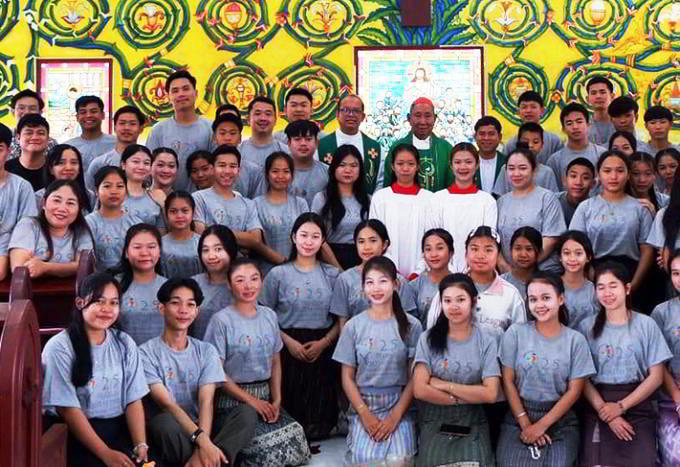
One of the most notable characteristics of the Laotian Church is the leading role played by the laity and young people. “The involvement of the laity – who serve as catechists and pastoral animators – is fundamental, and young people participate enthusiastically in pastoral life.”
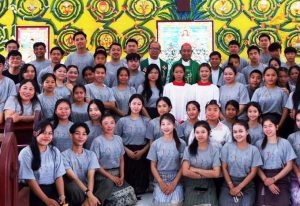
Demonstrating a special commitment to the human and spiritual growth of young people, the local Church is organizing the participation of a youth delegation from Laos and Cambodia in World Youth Day (WYD), to be held in South Korea in 2027.
Today, the local Church numbers approximately 50,000 faithful, organized into four apostolic vicariates: Vientiane, Thakhek, Paksé, and Luang Prabang. Since 1975, when the communist government expelled all missionaries, the Church personnel has been exclusively Laotian: one cardinal, three bishops, about fifty priests, one local religious congregation, and twelve international congregations comprising nearly 150 religious men and women, alongside some twenty major seminarians and forty minor seminarians.
In a predominantly Buddhist context, the small Catholic community lives out its faith and celebrates the sacraments in parishes, while also engaging in healthcare, education, and community development initiatives. (Paolo Affatato) – (The local Church is organising the participation of a youth delegation from Laos and Cambodia in World Youth Day (WYD), to be held in South Korea in 2027. Photo HIS)