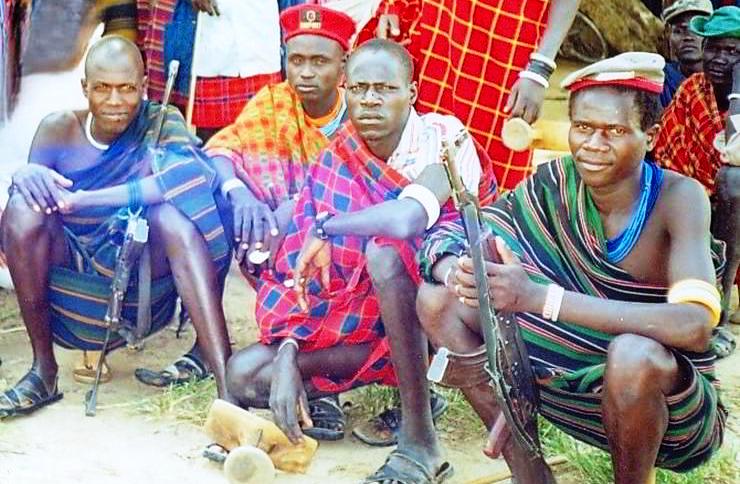
The Karamoja region has always been marked by violence. A project by the local diocese of Kotido is now supporting former Karimojong fighters on a new path of dialogue and personal and community growth.
It’s one in the afternoon when, under the vast sky of Kotido, Karamoja, in northeastern Uganda, an important dialogue begins among several Karimojong groups, mediated by the Justice and Peace Department (JPD-K) of the Diocese of Kotido. Dozens of former combatants are abandoning their guns and rebuilding their lives through community farming.
The Karimojong are semi-nomadic herders who live in the semi-arid Karamoja plateau and have always been feared as cattle raiders. This practice, rooted in the community’s cultural tradition, has over time become the primary means of sustenance for many families. In the region, alternatives have always been limited, both due to the scarcity of natural resources and a history of neglect and marginalisation by the state.
Karamoja has been experiencing a crisis of insecurity and poverty for over 60 years, since the beginning of the post-colonial era. After the fall of Idi Amin’s regime in 1979, thousands of weapons ended up in the hands of raiding communities. “Before President Yoweri Museveni’s disarmament policies began, it was unthinkable to travel these roads at night,” recalls Charles Ichogor, district commissioner (a local government representative) of Kotido. “Everyone, Ichogor continues, held rifles, and the risk of losing their lives in a raid was very high.”
In 2006, the armed forces intervened to reduce the number of weapons in the region, and thus the potential for conflict between communities, granting amnesty to all guerrillas who voluntarily handed over their weapons. Within a short time, hundreds of Karachuna (young fighters, in the local language) chose to abandon their rifles, and levels of insecurity began to decrease visibly.
Anyone who wished to continue raiding would have accepted the risk of falling into the hands of the army, and therefore of being tortured in prison or killed by military bullets: the order was to shoot on sight anyone suspected of being a raider. Thus, 13 years of relative peace passed in Karamoja, with sporadic incidents of raids, thefts, and road attacks.
In 2019, a new wave of violence and armed conflict began that engulfed the region for nearly four years. The COVID-19 pandemic exacerbated poverty, malnutrition, and limited access to education, healthcare, and employment—problems that had been ignored by the government during peacetime. “No one bothered to address the root causes of insecurity”, explains Peter Lopuko, Project Officer at JPD-K. “If people had alternatives to feed themselves and support their families financially, they wouldn’t choose the life of a raider,” adds Lopuko.
According to JPD-K’s analysis, this new wave has been characterised by two elements distinct from past cycles of violence. The first is the phenomenon of collaborationism, where members of one community are prepared to act as spies for “rival” communities, providing strategic information.
The second is the emergence of the government informant within communities, who, in exchange for money, reports raiders from their own group to the police. “This irreparably destroyed our internal social fabric,” says Lokoro, a young former raider from the Loletio community. “People stopped trusting their families, and violence began to spread.” Anyone suspected of being an informer could be lynched by their own community.
In this context, JPD-K has made a strategic contribution to the peace process. “There are many young people who want to abandon their weapons, but they don’t because they have no alternatives: we try to provide them,” explains Lopuko.
“In recent years – continues the Project Officer, we have involved thousands of people in dialogue and reconciliation activities and are supporting over 650 ex-Karachunas in agricultural training, beekeeping, and community savings.”
The JPD-K program aims to rebuild the social fabric in Karamoja through involvement in agricultural activities, agro-pastoral schools, the distribution of tools and seeds, and literacy courses. Young Karachunas are initially involved in these activities through dialogue and peace awareness initiatives, supported by the use of radio, which is the most widespread means of communication in the local context.
This has allowed JPD-K to spread the message of disarmament even in those communities that, due to the high level of insecurity, had never been reached by either the government or other organizations present in the area.
Once contact is established, JPD-K supports the raiders in meeting with local authorities, who are responsible for managing the surrender of weapons. Then the actual integration process begins, consisting of vocational training courses and support for starting income-generating activities, especially in agriculture and agroforestry. (Francesco Torri) – (File swm)