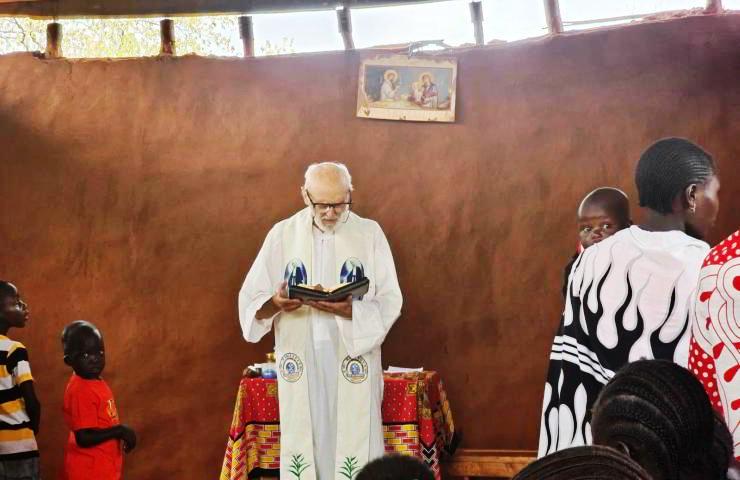
Fr. Juan Manuel Labajo Pejenaute, a Spanish Comboni missionary, takes us to his Amakuriat mission among the Pokot ethnic group.
Our parish in Amakuriat, a small town in northwestern Kenya, is dedicated to Our Lady of Peace. We live with the Pokot people in a mountainous area, about 1,600 meters above sea level, with a very pleasant climate. We are four Comboni missionaries in community: a Sudanese, a Kenyan, a Mexican, and myself, a Spaniard.
We also have a community of five Comboni Sisters who run the dispensary and assist with pastoral work. In addition, a few months ago, a community with three Comboni Lay Missionaries was opened in Chelopoy, one of our chapels.
We are people consecrated to the Lord and missionaries at the service of the Church. Every day begins early with community prayer and the Eucharist. Even though I’ve only been here a short time, I’m learning a lot about the Pokot people and culture. Every Wednesday, when I can, I go to the large local market. Since everything is bought, exchanged, and sold there, it is a privileged place to learn.
The Pokot are traditionally pastoralists, although recently they have also turned to agriculture as a complement to livestock farming, which is their main source of income. They are a welcoming and friendly people and lead a peaceful life, although they have repeatedly engaged in bloody clashes with their neighbours, the Turkana, also Kenyan, and the Karimojong, from Uganda, over livestock.
The extended Pokot family is polygamous. Men who have multiple wives and children by different mothers go from house to house to visit their families, but as they grow older, they sometimes suffer neglect from their children and are abandoned to their fate. Mothers are responsible for the arduous household chores and childcare.
The family decides who attends school and who takes care of the herding, resulting in many children and youth being left without an education and spending their days tending livestock. Local authority, previously vested in the council of elders, is now being transferred to local politicians and school authorities. Although it was neglected for years, the central and regional governments have now built schools, clinics, and wells in almost every community.
The major unresolved issue remains that of a road to facilitate access. The current road to Amakuriat is in terrible condition, discouraging potential visitors. They have attempted to build it in the past, but the conservative nature of the Pokot led them to oppose its construction for fear that the arrival of outsiders would disrupt their social and cultural traditions.
Our parish territory is quite large. We serve 53 small, scattered Christian communities, some of which are more than three hours’ drive away on difficult roads. We four Comboni Missionaries, in groups of two, alternate visiting them each week and spending a few days with the people.
The bishop of our diocese plans to establish a new parish, which will be administered by another missionary congregation and will occupy part of our territory, so as to better assist these communities pastorally. As it could not be otherwise, we are here to evangelise the people with whom we share our daily lives. Our model is Jesus Christ, who taught and loved as God, but who also “spent his life doing good” with the power of the Spirit. This is what we try to do in Amakuriat: spend our lives “doing good.”
In addition to the sacramental celebrations that build and sustain our Christian life, we run a small dispensary, build schools, help children and young people with their education, assist a group of disabled children, organize courses to promote Christian values in families, train catechists and community leaders, run a bakery that provides Amakuriat with its “daily bread,” and rely on a Comboni Brother who is an expert water diviner for community wells.
We are people consecrated to the Lord and missionaries at the service of the Church. Together with a group of lay people, last January, we opened a guest house with 15 beds and a small restaurant, the proceeds of which cover the expenses of the parish.