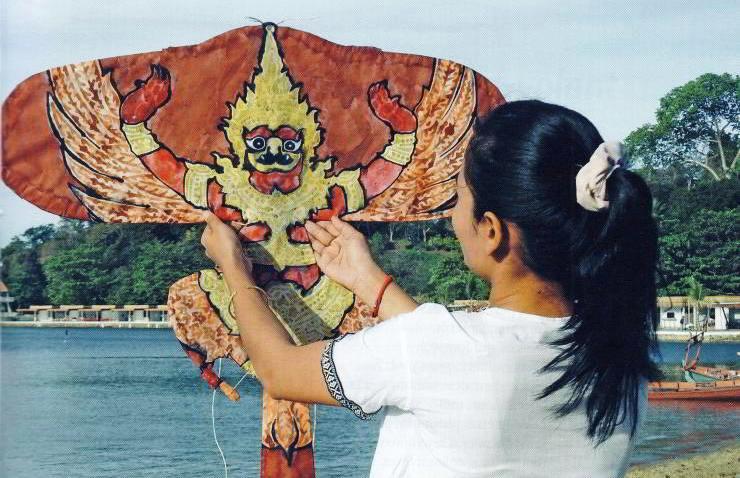
The kite is an Asian invention. Numerous festivals are dedicated to kites. Asian peoples consider them to be bearers of a universal symbol that connects earth and sky, the profane and the sacred, and the material and the spiritual.
In the Khmer language, the word for kite is khlaɛ: ɲ. In fact, this word originally had a different meaning that has since fallen into disuse. It refers to the osprey (pandion haliætus), a species of diurnal bird of prey found throughout much of the world, including Southeast Asia.
The most emblematic traditional kites are the “pnong” kites. This name dates back to before the Funan era, that is, before the birth of the Khmer people. It derives phonetically from the word “prolceng,” meaning “soul,” since the kite is a universal symbol that connects earth and heaven.
The first kite was invented in the Indonesian archipelago during prehistoric times. It was invented by a sea-fishing people, experts in harnessing wind power. Before becoming widespread, this type of kite spread initially to Southeast Asia, where, over the centuries, each country developed its own tradition. Kites have been flown in the Southeast Asian peninsula for at least two thousand years. No one knows when the final design of the various Khmer kite shapes dates back to. Today, only the characteristic pnong and kandong kites survive.
The date of the legend of Thon Chey is unknown, but, like all legends, it has a meaning. Perhaps it was invented to tell the story of the Khmer ancestors who exported the kite to China, which, from a historical perspective, is entirely plausible.
The Khmer settled in the east as early as the 10th century, before this territory was populated. Many peoples were influenced by the Khmer Empire and thus adopted the Khmer customs and traditions of the time. In the 14th century, the Siamois founded their kingdom, taking advantage of the decline of the Khmer Empire. However, they adopted the dominant religion and local culture, partially adopting the Khmer tradition of kite flying.
The Khmer legend of Thon Chey tells how this ingenious man escaped the clutches of the Chinese emperor thanks to the invention of the kite. Bearing a universal symbol linking earth and heaven, the profane and the sacred, the material and the spiritual, kites were used in Cambodia for royal ceremonies and religious rites. The belief that bad luck would befall a house on which a kite fell persists to this day.
This superstition explains why kites are usually flown far from homes. In the Southeast Asian peninsula, the kite season coincides with the dry season, which runs from harvest time to New Year’s Eve, from December to April. These have always been the months of the year when farmers are least busy. This period is also meteorologically favourable, as the winds are more regular.
Pnong kites are primarily flown by adults, especially men. Given their size, it is preferable to have several people flying them. This game fosters a collective and intergenerational dimension. Apart from the excitement or tranquillity this game provides, these kite flyers generally feel great pride in perpetuating an ancestral tradition that disappeared during the war years.
Although increasingly rare, adult men sometimes play kite wrestling. This involves trying to make the kites collide in the air or covering the strings with bitumen, then sticking glass fragments to them to cut the string of the other kite. The winner is the one who continues to fly.
In some villages, the use of sharp strings is prohibited due to the danger of this game. At night, a Lucanian activity involves attaching lanterns to the kites. This rare practice is practised during festivals. It is a symbolic expression of unity between the different villages.
Historically, those who had harvested and husked the rice first shared their joy by flying luminous kites. There are competitions in which the sounds produced by musical kites are compared. The one whose rattan slats produce the most melodious music wins. The best kites produce up to five, or even seven different tones, corresponding to traditional five-, six-, or seven-note songs. There was even a time when some kites used as many as two sticks on a single kite. (Text & Photo: Yann Defond/MEP)