The Comboni Missionaries have been working in the region for over 20 years. They operate schools in villages, teach agricultural methods, and assist those displaced by ethnic conflicts. They have transcribed the Gumuz language for the first time, creating a grammar that allows the Gumuz community to pass on their culture.
In Gilgel Beles, a town nestled in the northern Benishangul-Gumuz region, shops open early, but the days pass slowly. No traffic, only carts pulled by donkeys and goats that wander through dusty streets and small buildings. Until twenty years ago, Gilgel Beles was little more than a village lost among the hills and savannah along a road that descends west from the mountains of the nearby Amhara region to the plains that lead to Sudan.
Only about 10 years ago, when construction began on the Grand Ethiopian Renaissance Dam (GERD) about 160 kilometres away, did it gain infrastructure, thanks to increased connectivity and trade. Secluded among the trees on a side street at the entrance to the town, stands the church of Saint Mary, recognisable by its ochre and red hues. Not far away stands a small Comboni mission, a simple building with walls blackened by humidity, surrounded by a vegetable garden and with a chicken coop to the rear.
Founded over twenty years ago, it retains a familiar atmosphere, steeped in memories. The interiors are simple: a single room houses the dining room and a living room with armchairs arranged around a small table.
Father Marco Innocenti, a 54-year-old Italian, tall and smiling, with a direct and frank tone, is having coffee with Father Abraham Hailu, a 63-year-old Ethiopian, a reserved man with a calm demeanour. The two discuss some land, entrusted to the mission by village leaders. These plots are intended for the training of young people, to teach them how to use the land and develop sustainable agriculture. Farming is not a given in these parts because the Gumuz, the Nilo-Saharan ethnic group to whom the Comboni Missionaries have dedicated their mission, are hunter-gatherers and therefore inexperienced in the field.
Father Marco explains, “They will have to learn to cultivate the land more efficiently. Culturally, the Gumuz don’t plan for the future. They burn the undergrowth, then, before the rains, they sow a little sorghum or millet and wait. After the harvest, they go out to look for other things, like mushrooms, fruit, and honey, in addition to fishing and hunting at the right times.”
He then explains, “in such a crowded, unstable Ethiopia, where everyone is looking for land, it’s impossible to think of remaining isolated. We must be open to change and exploit it before we are swallowed up.”
The Comboni Missionaries travel to the most remote Gumuz villages, scattered inland in the Metekel Zone, one of the three administrative areas of the Benishangul-Gumuz region. At the edge of one of the freshly ploughed fields, Father Abraham descends and meets some village boys, whom he teaches basic farming techniques.
Father Marco continues along the dirt roads that cross a still largely uncontaminated, fertile, and uninhabited territory. Every now and then, among the tall grass or along the roadside, solitary figures can be glimpsed: mostly women, carrying firewood or water cans hanging from the ends of a stick slung over their shoulders.
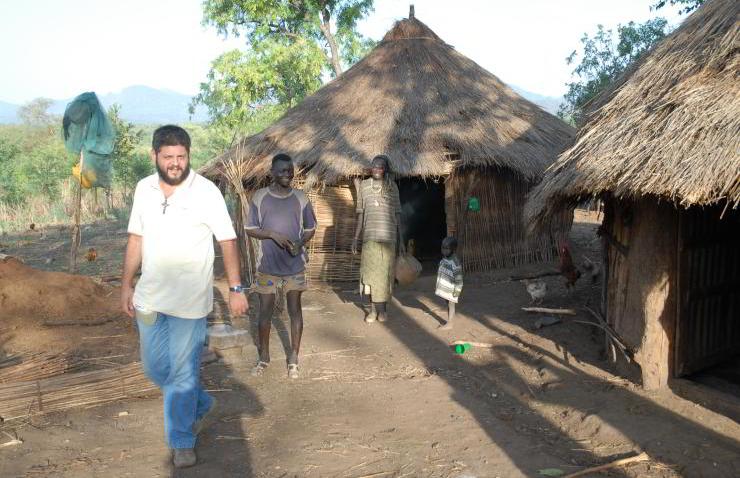
The Gumuz people live in small mud and straw huts far from inhabited centres and the road. They follow the cycle of the seasons in profound symbiosis with the environment. They are divided into 10 clans, speak their own language and are estimated to number around 250,000, scattered across Ethiopia and just beyond the border, in Sudan. Their ancestral lands originally lay north of the Blue Nile, along the banks of one of its tributaries, the Beles River.
The landscape unfolds, and Father Marco points out places and anecdotes about villages where he built small schools and chapels where he celebrated Mass on weekends. He was among the first missionaries to move here when there was practically nothing, and access was extremely difficult. “To reach the villages, you had to walk through the forest for days on end, and it took time to integrate,” he says. “The priority of our mission has always been education and the development of critical thinking,” explains the Comboni Missionary.
According to the Comboni Missionary, although these lands officially belong to the Gumuz, they have been repeatedly targeted by private companies engaged in land-grabbing. The construction of the GERD dam has also exacerbated tensions, forcing the displacement of 20,000 people. Meanwhile, other ethnic groups from the highlands have settled unchecked, controlling trade, agriculture, and services for years. However, they do not enjoy the same political rights as indigenous communities and also feel marginalised. Before 1995, the area north of the Blue Nile was part of the imperial province of Gojjam, with a majority Amhara population.
“Amhara ethnonationalists continue to consider Metekel as their own,” adds Father Marco. “When the first violence began, it didn’t take much to inflame tempers. There were massacres on both sides, and despite our attempts at mediation, the thirst for revenge prevailed.”
According to the Ethiopia Peace Observatory, from 2018 to 2022, the Metekel area was among those characterised by tensions. Between 2018 and 2024, it is estimated that there were over 1,500 victims of ethno-political violence. The mission faced its most challenging period between 2019 and 2022, during which 70,000 people were displaced. “There was a state of emergency, and everything was militarised. Many Gumuz arrived here because their lands had been occupied. Together with the Franciscan nuns, we tried to provide food and medical care, but those were dramatic days. These events worsened the living conditions of our communities.”
The violence has decreased since 2023, following the signing of peace agreements with the Gumuz rebels, but the consequences are still being felt. Electrification projects and new wells are blocked, while many schools and medical clinics have not yet reopened due to a lack of trained personnel from other ethnic groups. Furthermore, the Gumuz no longer feel they can access the areas where they once hunted and fished freely. Father Marco thinks that things have worsened and that a climate of uncertainty persists among the communities. “It’s as if it were only a truce because the adversaries are engaged on other fronts,” he says worriedly, referring to the ongoing conflicts in Amhara and Oromia.
The missionary adds several aspects these people need to learn about, such as early marriages and trust in traditional medicine, which hinder the prevention and treatment of easily eradicated diseases. At the same time, new trends have corrupted Gumuz culture, such as alcohol, artisanal gold mining, and unregulated deforestation. Once upon a time, cutting down a small plant or tree required lengthy rituals, but today this is no longer the case. Their culture must be preserved in this sense.”
In addition to these missionary activities, over the years Father Marco has carried out the first transcription of the Gumuz language and drafted its basic grammar. “When I arrived among the Gumuz, I spoke only Amharic. I began speaking with them, having short sentences translated by the few children who had at least a basic education. I began recording more complex sentences and then stories. And that’s how I began to write down their grammar”, he says.
The missionary sought analogies with other Nilotic languages in the region, but “this must have always remained locked away in these forests.” “Only after years did I manage to find the key to the grammar and create rules.” This was a painstakingly time-consuming task because, being a tonal language, it also required an alphabet, which Father Marco meticulously prepared, laying the foundation for its teaching not only for missionaries and researchers, but also for the community itself. “If the Gumuz can continue to use this language, it will be a source of pride; they will be able to feel like a people, remain united in the face of change, and find their place in the world.” (Marco Simoncelli)