Father Romulo Panis talks about his journey to the priesthood and his missionary experiences.
After a childhood shaped by the Eucharist and the gentle guidance of Mary, Father Romulo answered a call that carried him to mission fields in Africa and Central America— where faith, danger, and culture forged a life of service.
My father was an extraordinary minister of the Eucharist and also a member of the Knights of Columbus. My parents used to tell us to put God first in our lives; to participate first in the Eucharistic celebration, then other activities can follow.
Our Blessed Virgin Mary made a significant impact on my vocation. After my first Holy Communion, my catechist gifted me a Rosary. That Rosary accompanied me everywhere I go, not until I lost it recently before coming back here in the Philippines. I felt sad. My Rosary had been with me for fifty years.
However, the most important thing is my personal relationship and love for the beloved Blessed Mother Mary, who always accompanied me from the beginning. I became a volunteer catechist and member of the choir in our parish. I went to a poor area of my parish and taught catechism. I finished my studies and then started working.
One day, a Comboni missionary invited me to a three-day search-in vocation program. At that event, I discovered that God was calling me to be a missionary. I was attracted by the missionaries working in Africa. I entered Saint Daniel Comboni Seminary and studied philosophy at Christ the King seminary.
Then, I continued my formation as a scholastic in Nairobi, Kenya, where I studied theology and missiology. After my second year of theology, we were sent to a mission area to experience community life and the realities of the mission. I was sent to Lira, in northern Uganda, where I had contracted severe malaria; fortunately, I survived by taking the medicine, Quinine.
Having malaria is like a baptism for being a Comboni missionary in Africa. When I arrived in Lira, Uganda, I could not sleep for a week because of the war. We did not know when the rebels would come to our mission area. During that time, there was civil unrest because of the war. Many children were kidnapped by the rebels to be trained as soldiers.
These challenging experiences during my formation have helped me to ask myself, “Romulo, you know now what it means to be a Comboni missionary. Are you still thinking of being ordained?” And I told myself, “If I go back in time, before I entered the seminary, I will decide to enter again.”
I was ordained a priest on June 30, 2001. My first missionary assignment was in Central America. I studied Spanish in Guatemala in September 2001, then went to El Salvador in 2003, in the place of Saint Arnulfo Romero. Still, another different reality of violence came up, and this is by the group of gangsters called Mareros.
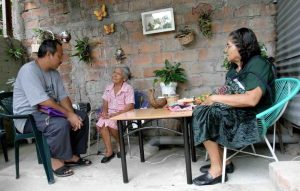
Many were killed because of these gangsters, and many people feared going out of their houses at night. In 2018, I was sent to Guatemala in Parroquia, San Luis IX Rey de Francia, Peten. The land area is approximately 2,915 km squared, whose population comprises 80 percent of the indigenous Maya Q’eqchi’. The parish has 145 communities.
The Comboni missionaries work in inculturation in the Q’eqchi’ culture. Inculturation of the Gospel is a profound and transformative process that seeks to integrate the cultural values and traditions of peoples with the universal message of Christ in the context of our beloved parish. There is a dialogue between faith and culture that allowed the Gospel to resonate authentically and meaningfully in the hearts of people. The dialogue between the Christian faith and local culture is essential for the inculturation of the Gospel. This profound and respectful process allows the Christian message to be incarnated in the culture.
Before coming back to the Philippines for a new assignment, I received a letter from a youth in a community I served; it touched my heart deeply. He wrote, “Dear Father Romulo: Today I write to you with a heart full of gratitude, and also with a little sadness, because I know your return is near and you will probably not come back to our community again. Although we shared Masses and services for several years, you may not remember me by name.”
The letter continues: “However, I remember you very well, because your presence as a missionary left an imprint on all of us, especially on those of us who had the privilege of serving as altar servers by your side. Through you, we learned that being a missionary priest is more than just celebrating Mass. It is living with the people, laughing, teaching, accompanying, being present, and giving hope… And that is what you did. And although the years have passed, and you may not have had time to get to know each of us deeply, your dedication spoke louder than a thousand words… With all my love and prayers, Cesar Augusto (Altar boy from Chacte, Guatemala).”