“In the midst of this great darkness we are experiencing today in Israel and Palestine, many candles are burning: people who lead with their talents, who accompany with courage, who warm hearts with their service, and who inspire by their silent resistance.” Sister Lorena Cecilia Sessaty Saenz shares her experience with us.
“I’ve stopped dreaming. There’s too much suffering here.” The words of Khader, a Palestinian boy of just 17, spoken in a dry and irritated tone, left me speechless. It wasn’t a dramatic statement or an act of rebellion against the situation. It was an observation born of profound weariness and evident disgust.
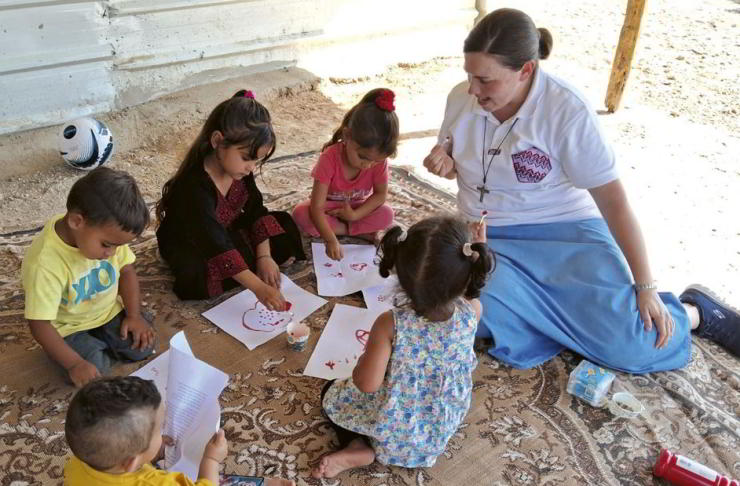
I am a Mexican Comboni Missionary Sister, and I have been working for a little over a year at Bailasan, a psychological and spiritual support centre in Bethlehem. The conflict we are experiencing not only brings visible death and destruction, but also a long series of collateral consequences. Bethlehem, whose economy depends almost entirely on tourism, is practically paralysed.
The economic collapse is resulting in increased cases of stress and depression, families separated by forced migration, interrupted careers, life plans put on hold, young people who haven’t left their homes for years, and an ever-increasing reliance on the digital world as a means of escape.
Among these stories, Mahmud Darwish’s poem “Think of Others” comes to mind. Often, faced with certain stories and my own helplessness, I have silently repeated the poem’s closing line: “If only I were a candle in the darkness.” A candle, a light capable of illuminating the shadows left by conflict, the darkness of division and violence. A small light that tries to make its way despite the difficulties of language, culture, distance, and my own limitations.
And yet, in my attempt to be a light for others, I find myself illuminated by the light of many candles I encounter along this path. I think of Tariq, Raed, Gina, and Mohamad, whose families endured expulsion and the harshness of growing up in refugee camps, and who today have become experts at bringing smiles to children through plays and puppet shows.
I also think of Shoshana, Betina, Natania, and so many other Jews who dedicate their time and energy to the cause of justice and who often face rejection and criticism from their own people for their actions for peace. Amid this great darkness we experience today in Israel and Palestine, a darkness that sometimes seems to spread maliciously, there are many lighted candles: people who lead with their talents, who accompany with courage, who warm hearts with their service, and who inspire with their silent resistance.
At Bailasan, during therapy sessions, workshops, or support groups, we always light a candle. But the true fire is found in the strength and inner wisdom of the people who participate. For me, this is nothing less than the Holy Spirit acting and illuminating from within.
Going back to Khader’s story: after a period of guidance, we presented the biblical story of David and Goliath during one of the workshops. I was struck by the way Khader explained that David helped him realise he was clinging to “armour” that was not his own: dreams and desires that, instead of encouraging, paralysed him, increasing his sense of helplessness and “weighing down his heart.” Armour that, rather than protecting him, hindered him.
Khader listed his slingshot and the five stones, the resources he uses every day: his health, his love for the scouts, his family, his faith, and his best friend. He recognised that he couldn’t change the sociopolitical situation, but he could defeat the Goliath of resentment and apathy that challenged him.
I understand Khader. I, too, have dreams that hurt when they collide with everyday reality: for the occupation to end, for the violence to cease, and for the 700-kilometre wall of separation to be torn down. Dreaming like this today, for my mission as a Comboni Missionary, would become heavy armour that would limit my ability to act, weighing down my heart, as happened to Khader.
My mission today is more like a candle: “If only I were a candle in the darkness.” To accompany, encourage, listen, and create connections. To carefully touch the wounds and gradually break down the walls of indifference.
In this wounded land, I continue to discover that God has not stopped working. He keeps his light burning within me, confirms me in my mission, and reminds me that it is he who fulfils it.