The festival of La Tirana, in Chile, celebrates the Christian faith – invoking the Virgin of Carmel – and recalls a colonial-era legend of love and faith, centred on a young Inca warrior and a Portuguese man. The festivities combine Catholic religious elements and Andean cultural traditions.
The small Chilean village of La Tirana, at 1,100 meters above sea level, lies west of the Atacama Desert, in the Pampa del Tamarugal, 72 kilometres from the port of Iquique, capital of the Tarapacá region on the northern Chilean coast. During the week of July 16, thousands of pilgrims visit the village for the feast of Our Lady of Mount Carmel. This celebration has traditions dating back to the colonial period, blending the Catholic faith with Andean customs.
There is an ancient legend with historical foundations surrounding the origins of La Tirana and its miraculous Virgin, collected and disseminated by Peruvian historian Rómulo Cuneo Vida and cited by Juan Uribe Echevarría in his work Fiesta de La Tirana de Tarapacá.
The story goes that, around 1535, the Spanish advanced to conquer the territory of the Inca Empire, accompanied by several indigenous peoples, including Paullu Tupac, prince of the Inca lineage, Huillac Huma, the last high priest of the extinct cult of the Sun, and his twenty-two-year-old daughter, a warrior and priestess, Nusta Huma. Shortly thereafter, the Inca priest, who despised the Spanish for invading his lands and enslaving his people, accompanied by a group of followers, separated from the Spanish troops and fled to Charcas.
Later, his daughter Nusta Huma also fled with a group of Incas and took refuge in what is now known as the Pampas of Tamarugal. The young Inca warrior became a feared and respected military leader, nicknamed the Beautiful Tirana of Tamarugal. She dominated that region for four years, counting on the support of neighbouring tribes who united in protest against foreign domination. And in that place of resistance, there was a rule: kill all Spaniards or baptised indigenous people.
One day, a foreigner captured near that jungle was brought before her. When questioned, he said his name was Vasco de Almeida and that he belonged to a group of Portuguese miners who were in Huantajaya. He had travelled and arrived there seeking the Mina del Sol. Coming together, the elders decided to apply the death penalty.
However, on that occasion, Nusta Huma felt compassion for the prisoner. In her role as priestess, she postponed the sentence for four months to consult the stars and the gods. The young woman visited the prisoner frequently, and they ended up falling in love. They began a secret relationship. The Portuguese also spoke to her about the Christian faith, and Nusta Huillac eventually converted to Catholicism. Discovered, they were sentenced to death.
Shortly before dying, Almeida baptised his beloved, and she, wounded by the arrows they shot at her, cried out again: “I die happy, certain as I am, by my faith in Jesus Christ, that my immortal soul will ascend to Glory and I will contemplate my Creator.”
In the 1540s and 1550s, Friar Antonio Rondón, a Mercedarian and evangelizer of the region, arrived in Tamarugal and found a wooden cross. He saw this as a sign from Heaven and built a church there, named Our Lady of Carmel of La Tirana. The church soon became a place of pilgrimage for the inhabitants of this desert region and also those from more distant areas.
In the 19th century, Chile won the War of the Pacific—a conflict that lasted from 1879 to 1884—and annexed areas rich in natural resources from Bolivia and Peru, including the Peruvian territory of Tarapacá. However, the La Tirana celebrations continue to bring together and unite the peoples and traditions of the three countries.
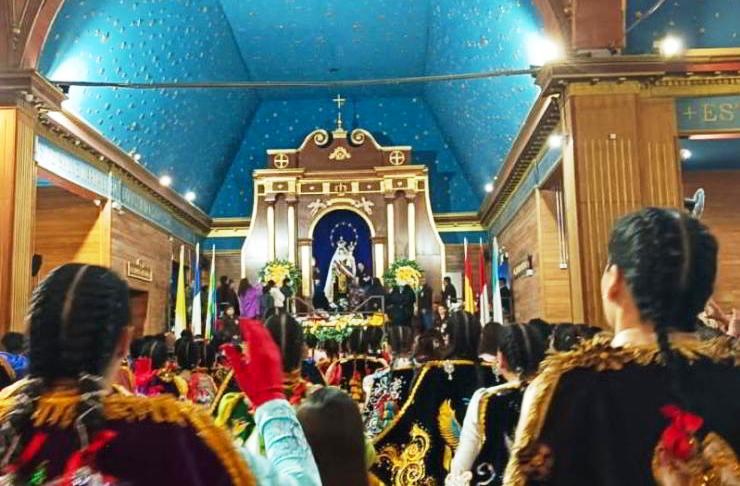
Starting on July 14, pilgrims begin arriving in La Tirana for the feast of Our Lady of Mount Carmel, or The Virgin of the Scapular. Various groups and brotherhoods, using pre-choreographed and rehearsed dances and songs with Andean rhythms, joyfully and enthusiastically express their faith and devotion. Performances include songs of entrance, greeting, adoration, offering, daybreak, good night, and farewell.
Participants parade in colourful costumes. Playing musical instruments (drums, flutes, matracas, quenas – a traditional Andean flute made of bamboo, wood, or bone) and dancing joyfully, they go through the streets and finally gather in the churchyard, at the feet of the Virgin, for their prayers, songs, and dances, which integrate the ancestral customs of the indigenous, Creole, mestizo, and black peoples who occupied these lands in the past. On the 15th, at midnight, bonfires are lit in the square and bands accompany the dances until dawn.
July 16th is the liturgical feast of Our Lady of Mount Carmel (in reference to the apparition of the Virgin Mary to Saint Simon Stock in 1251). At dawn, the pilgrims put new energy into their morning chants and joyful dances as they prepared to participate in the Eucharist devoutly. In the afternoon, the procession in honour of the Virgin of Mount Carmel begins. Each brotherhood carries its own image of the Virgin, richly dressed and adorned. After the Catholic ceremonies, the celebration returns to the streets, featuring various religious and cultural events that continue until the following day.
An element present in the celebrations of La Tirana, common to other Latin American celebrations, is that of the masks, crafted and worn in various colours. One of the most famous is the “devil” mask. The “devils”—usually adult men, boys, or children—attend the celebration to pay religious vows dressed as devils. They perform dance/wrestling moves to the rhythm of the music, facing off against disguised members of the church. At the climax of the ritual, the “devils” ultimately surrender to the power of God. The performance serves to demonstrate the strength of the Church and the victory of good over evil. (Photo: Courtesy of Carmelita Misioneras ) – (Bernardino Frutuoso)