Amidst stifling heat, colonial memories, and still-open wounds, the port city of Massawa, Eritrea, appears like a mirage of stone and dust on the Red Sea.
Founded by the Arabs, it has endured domination and devastation, and today it exists suspended between ruins and resilience. A ghost town by day, it comes alive at night with the light breath of the sea breeze. It’s hot in Massawa, very hot, especially in August. If you then descend the dizzying colonial road that, with an endless series of hairpin bends, connects it in less than a hundred kilometres to the 2,300-meter altitude of Asmara, the impact is even more powerful.
“Three seasons in three hours,” say the Eritreans, joking about the sudden temperature changes that this journey from the highlands to the Red Sea coast entails. They are right: the thermometer doesn’t drop below 30 degrees Celsius even in the dead of night, while during the day it usually exceeds 45.
In the humid heat that envelops everything, the city appears like a shimmering mirage amid the azure sea. Spread across two small, flat islands connected to each other and to the mainland by long bridges, its forms and architecture tell a unique story of memories, domination, and still-open wounds.
Likely founded by the Arabs in the 7th century, it was ruled by the Portuguese, the Ottomans, Egypt, and finally Italy, which conquered it without a fight in 1885. During the Fascist era, Italy made it the “gateway to the Empire,” through which troops, weapons, and furnishings passed for the colonial aggression against Ethiopia.
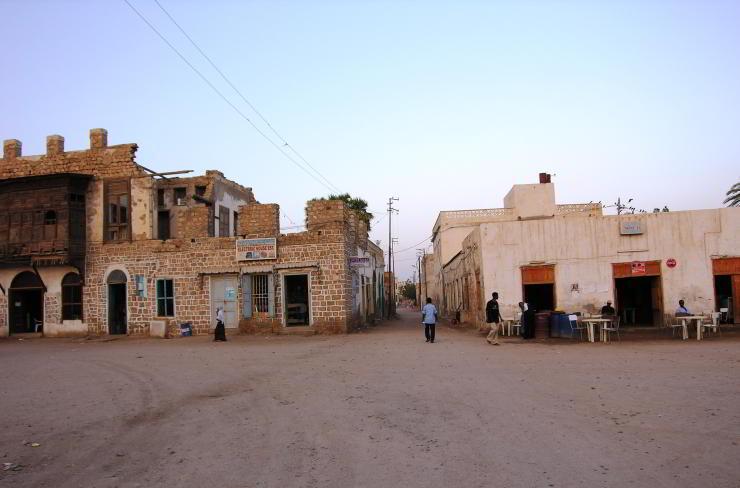
The island of Massawa, also known as Batsi, preserves the most ancient remnants of Arab and Ottoman rule: narrow alleys, doorways carved with inscriptions from the Quran, wooden sunshades that shield balconies and windows from the sun’s rays and prying eyes while allowing a constant stream of air to pass through, simple mosques with whitewashed domes and squat minarets.
The second island, called Taulud, was instead chosen by the Italian colonial administration as a place for the residences and services of officials and governors; a network of avenues and wide, regular streets still line eclectic or oriental-style villas, palaces, and hotels, which have been inexorably replaced by anonymous concrete buildings.
Massawa’s history, however, is one of devastation and destruction: the great earthquake of 1921 that almost entirely razed it, colonial master plans, and above all, the relentless battles of the 1980s to gain independence from the last dominant power: Ethiopia.
What remains is only the shadow of a diverse and flourishing past, barely discernible in its dusty streets, among the sun-bent rails, the holes in domes gutted by artillery fire, or in the piles of ancient stones overlooked by the rusting cranes of the port.
Everything seems exhausted in Massawa, worn down by the recurrence of history, a stifling present, and the relentless heat; everything has the appearance of a ruin, and it’s difficult to clearly discern what is ancient and what isn’t, which architecture has survived the centuries and which is recent or artificial: wars, fine dust, and the scorching power of the sun have worn away everything, enveloping this city of rubble in a patina of decay.
In the milky afternoon light, the stone walls of the half-ruined houses burn; we move close to them, searching for subtle shadows in the dim light of the few remaining porticos or in the narrowest streets of a ghost town that seems totally uninhabited.
Life begins at sunset, when a faint, humid, salty breeze rises from the Red Sea; Those who live here know the importance of the breeze, of exploiting every breath to survive the relentless heat, and so the streets slowly begin to come to life, shops open their heavy wooden doors, and small bars light up with dim neon lights.
But in August in Massawa, the heat is too intense even at night, so the doors of the houses are thrown open, simple camp beds are lined up on the sidewalks, and people pass the time or sleep outside, in the streets and courtyards.
We walk through the darkness of the dusty streets, surrounded by prone bodies and enveloped by inaudible voices, small crackling radios, whispers, or the heavy breathing of those who sleep. Public spaces have become living rooms, dining rooms, and bedrooms. We want to take a photo, or more, but the fear of appearing intrusive and the darkness prevent it. And perhaps this is only right: certain things must remain in the memory, uncertain and impalpable like mirages or early morning dreams. (Federico Monica/Africa)