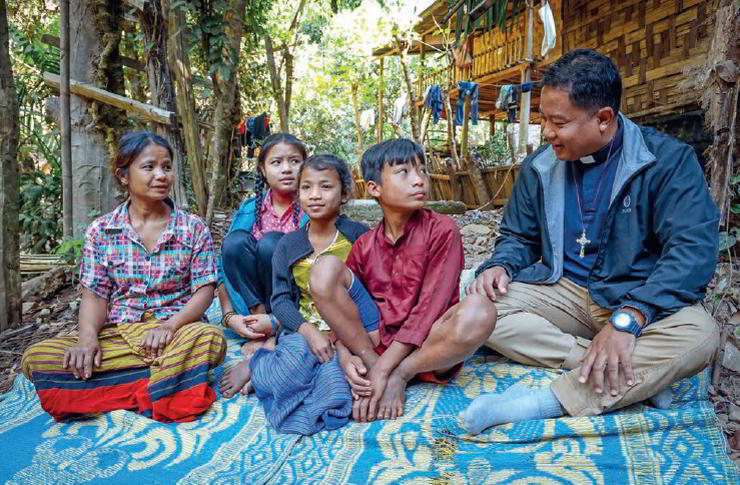
Father Dominico assists in two large refugee camps in Thailand to people who have fled Myanmar due to violence and injustice. The priest accompanies the refugees as a spiritual director. He himself is originally from Myanmar. He understands these people’s language, their culture, and their pain.
Narrow, dusty paths wind between simple bamboo houses. Children play happily; chickens scratch in the dirt. Father Dominico crosses a bamboo bridge over a river. He’s on his way to visit Anne Zin’s family, with her two daughters and son, Paul. They recently fled Myanmar. Paul, 13, is still in shock. Fighter jets bombed his home. The noise of the planes causes him to panic. Even in the refugee camp in Myanmar, the family wasn’t safe. As the bombings got closer, they fled to Thailand.
Now they sit, exhausted, in the shade on a rug. The children are troubled, silent, staring into space. Father Domenico crouches beside them, listening to them and asking questions gently. “Now you’re safe,” he says softly, trying to console them. “There are no more bombs here.” Even in the Ban Mae Surin camp, daily life is a struggle for survival. To buy food, the family had to borrow money from neighbours, who also offered them used clothes.
Now Anne hopes the children can return to school soon. Their father, Dominico, helps them find the right people to approach. Above all, he listens to them and encourages the children in their desire to learn. They dream of becoming nurses, teachers, or engineers.
Clare Aung, along with her five children, also found refuge in the camp. The family fled after soldiers burned down the entire village. Her 16-year-old son is blind and can’t walk due to polio. Clare had to carry him on her back. Later, a nephew helped her carry him across the border. The family also arrived a few days ago. Clare’s sister, who has lived longer in the camp, helped her find her way around. When Father Dominico realised they didn’t have any utensils, he got them some in a nearby town.
Father Dominico, like many refugees, belongs to the Karenni ethnic group and is originally from the Diocese of Loikaw. His village was burned down by the government army. His bishop sent him to the two refugee camps, where he works for the Jesuit Refugee Service. He celebrates Masses, gives retreats, offers counselling, makes home visits, and organises events.
In one home, together with a team, he cares for 36 children who are orphaned or living separated from their parents. The parents of siblings Luke, 15, Simon, 10, and Sarah, 9, died of cancer. Luke discovered in his mother’s diary that they had fled Myanmar because they had been tortured. For all those who have endured painful experiences, Father Dominic Nya Reh, as he is known in the Karenni language, is an important source of support. His calm and compassionate nature helps many to cope somehow with the difficult conditions in the camp.
“People tell me that my mere presence gives them the feeling that they haven’t been forgotten,” he says, hoping that everyone will one day return to their homeland.
The Ban Mai Nai Soi and Ban Mae Surin refugee camps are isolated, far from any infrastructure, on Thailand’s border with Myanmar. They host 13,000 refugees from Myanmar. Many of them had already fled to Thailand in the 1980s and 1990s, to escape armed conflict. After the military coup in Myanmar in 2021, a new exodus occurred. Officially, Thailand is no longer accepting new refugees. They are not registered or provided with food. People are not allowed to leave the camps. Informal education opportunities are offered in the camps. Teaching Thai is not permitted.
Thailand does not want these refugees to integrate into Thai society. Many have been living in the camps for years. The United States’ suspension of humanitarian aid has been a severe blow to the camp communities.
Health centres have been forced to close, and food is scarce. Without outside aid, the camps are under enormous pressure. (Bettina Tiburzy/Missio) – (Photo: Hartmut Schwarzbach/Missio)