On the African continent, the history of many peoples is intertwined with the infinite variety of hand-woven textiles, whose production methods have become part of a country’s cultural heritage. Passed down from generation to generation, African textiles stand the test of time and fashion.
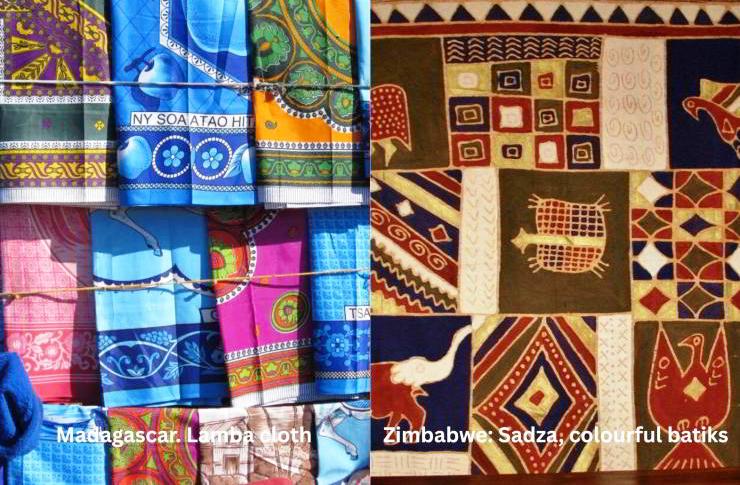
Madagascar. Lamba cloth: memories, art and identity
In Madagascar, the home of the lamba, also known as “simbo,” a rectangular cloth with substantial symbolic value in Malagasy culture, that accompanies the population through all important stages of life. Used from early childhood to wrap babies on their mothers’ backs, or in adulthood as a ceremonial garment, the lamba also finds its place in funeral rituals, as a shroud.
The ways in which the lamba can be wrapped around the body, the material used for the cloth, and its colour vary depending on the region of Madagascar, its use, and the occasion. The lamba worn in everyday life, for example, is usually made of raffia, pigskin, or cotton. In contrast, the traditional lambas worn for burials are larger, white, and made of silk and cowhide.
They come in a variety of colours and geometric decorations, including black-and-white, red-striped, shades of green, and other bright colours. Women traditionally wear them as a dress or wrapped around their waist. Men can wear it around the waist or as a stole over their shoulder.
Lambas are usually made by women and woven on looms by Sakalava villagers. Those with the most complex geometric patterns are called lamba akotofahana and are made using a special weaving technique. Their quality has been highly appreciated in recent years, to the point that they have become a true textile art, opening their doors to galleries in Antananarivo. This transformation is the result of the quality of the Lamba, as well as the work of local artists who have artistically reworked these fabrics, which have since been exhibited in world-renowned museums.
Zimbabwe: Sadza, colourful batiks made with corn flour
Today, we travel to Zimbabwe, where beautiful batiks are created using a unique ingredient: corn flour paste. Eastern Zimbabwe has a long tradition of producing sturdy, naturally coloured rugs.
While the original batik process uses wax, in Zimbabwe, the process is adapted by mixing the fibres with corn flour, known locally as sadza.
The fabric is then hand-painted, a characteristic of each piece. With a steady hand, artisans create the designs and use everyday tools to modify them and achieve a unique finish.
After the painted fabric dries for a few days in the sun, it is baked at about 150 degrees Celsius. The paste is scraped by hand to reveal the white lines it leaves. The cloth is then washed and brought outside to dry in the sun. After this, the fabric is ready to be made into cushion covers, bags, bedspreads, and tablecloths.