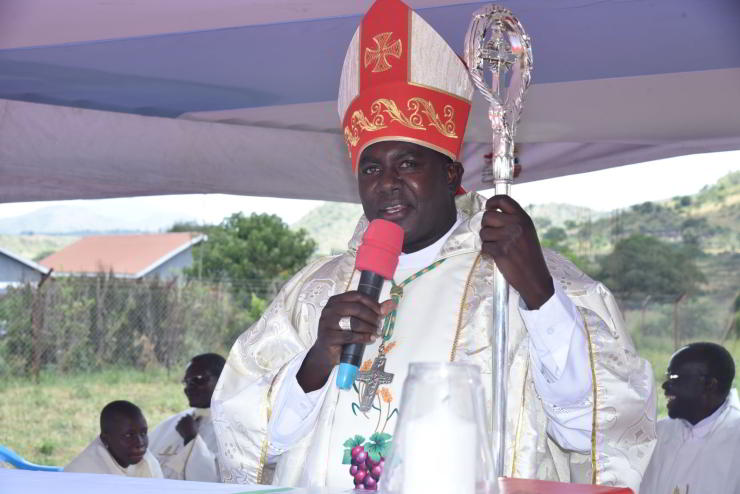
Comboni Bishop Dominic Eibu of Kotido diocese shares his vocation journey and missionary experience.
I had no idea about the priesthood, though I enjoyed seeing priests whenever they came to our village chapel, which was rare. At secondary school, I wanted to be a bank manager! I was inspired to join the Comboni Missionaries in a very funny way while I was at Moroto High School. It all happened like this: I used to pray at Regina Mundi Cathedral, where the parish priest was a family friend.
During the first term holidays, he asked me to help him in the parish office by entering the names of people who had received sacraments into the parish registers. One afternoon, on my way to work, I met an old man riding an old Vespa motorcycle who was probably going out on his mission.
I did not know him! I stopped and was disturbed by some questions that came into my mind there and then: who is this old man, who seems committed to our people, but who is not Ugandan? What will happen when he dies? Who will continue his work? I continued to the parish office to collect my assignment and, when I reached the parish priest, I asked him who the old man was, describing him as I had done. He told me that he was a Comboni missionary. I then asked him how one could join them. Although I asked him this, I had a ‘difficulty’ that I thought would prevent me from joining the priesthood: I had not studied Divinity at school as I had been placed in the science stream.
When I told the parish priest about this ‘difficulty’, he assured me that I could still apply to the seminary if I was interested in seminary life. However, he told me that the Verona Fathers only accept candidates who have completed high school. I didn’t even know the difference between priests, whether they were missionaries or diocesans, or anything like that. Nevertheless, the parish priest encouraged me to apply to join the seminary.
I applied without knowing where I was going, just that I wanted to become a Comboni Missionary! After passing the exams, I was admitted to the Apostles of Jesus Minor Seminary in Nadiket, Moroto. When I arrived in Nadiket, I didn’t see the old man, so I asked the parish priest where he was. He told me again that they were Comboni Missionaries, but encouraged me to study for my A-Levels there. He assured me that if I was still interested by the end, he would notify the Comboni Missionaries’ vocations director.
After my final exams, I received a letter from him asking me to prepare to meet the Comboni Missionaries’ Vocation Director at Comboni House in Moroto on a certain day, which I did. I had a positive encounter with the Vocation Director, who asked me to apply on the spot. I did so, and he invited me to go to Kampala to join other candidates for the orientation programme.
The orientation programme lasted a week, during which time he informed us that he would check our results at the Ministry of Education headquarters. Those who got the required marks would receive an admission letter. He also said that those who were accepted would need to report to Kampala so that they could be taken to Jinja to begin their postulancy.
My journey began in 1993 with a philosophy course in Jinja. From 1996 to 1998, I undertook my novitiate training in Namugongo, followed by a theology course from 1998 to 2002. Initially, the theology course was supposed to take place in Kinshasa, but due to political unrest, I was sent to Rome instead. I was ordained as a priest in 2002 and assigned to Khartoum in Sudan. Before going there, I was sent to Cairo to study Arabic from 2002 to 2003, and then to Rome from 2003 to 2005 to study Islamology. I went to Khartoum in 2005.
My first assignment was to Egypt to study Arabic, and then I was eventually posted to Khartoum in Sudan. While in Sudan, I undertook pastoral work in a school. From 2006 to 2016, I worked as the principal at Comboni College Khartoum (CCK) and Omdurman Boys Primary School in Sudan. From 2017 to 2022, I was based in Cairo at the Dar Comboni Institute for Arabic Language and Arab Culture, where I was also the director of three refugee schools belonging to our Sacred Heart Sakakini parish.
From 2017 to 2022, I was based in the parish, first as Assistant Parish Priest and then, from 2020, as Parish Priest. During this time, I also offered my services at the previously mentioned institute. Therefore, I have experience in both school and parish apostolates. I worked in Arab countries for a total of 16 years, i.e. 11 years in Khartoum, Sudan, and 5 years in Cairo, Egypt.
When I was appointed as a bishop, I felt lost! This was because I found myself in a new reality where I had to start dealing with much bigger responsibilities than parish work, school or the institute. Relying on the grace of God and the trust of the Church, I embraced it with faith and support from the Church.
Now, three years on, I have come to love my responsibilities, the people and the place. I am still learning how to serve my people well, including learning their language, attitudes, and culture, so that I may feel completely at home with them and in my role. I don’t fully understand the hearts of the people, but I feel that they love me and I love them too! I have been well accepted in the diocese, as evidenced by the new name I was given, ‘Lokut’, on the day of my Episcopal Consecration. This name reflects the conditions at my consecration as bishop – it was very windy!