“We continue to believe in the resurrection of South Sudan. We continue to proclaim that Emmanuel, God-with-us, never abandons his children. Even in the darkest nights, the Gospel remains a burning light. And no war can extinguish the power of God’s love.”
South Sudan is a wounded, crucified land. It is the world’s youngest country, created in 2011 after decades of war and suffering, when the people voted with hope for separation from North Sudan. Many finally dreamed of peace, freedom, the chance to build a new future.
But that dream quickly turned into a new nightmare: a bloody civil war continued to devastate the country, sowing death, hatred, and despair. Even today, thousands of innocents pay the price of violence and the thirst for power. And in the face of this immense pain, we understand that Christ continues to be crucified in the body of his people. Yet, precisely in the midst of this darkness, the Gospel continues to shine with surprising strength.
The Church among the Nuer was born from the courage of simple catechists. Poor men and women, fleeing war, hunger, and disease, they arrived in Nuer territory bringing with them only their faith in the Risen Lord. They had no resources, no security, but the fire of the Gospel burned in their hearts. Like Paul and Barnabas in the Acts of the Apostles, they travelled through villages and along paths, proclaiming that Jesus is alive and that no suffering can separate man from the love of God.
For nearly twenty-five years, these catechists guided the Church without priests, guarding the faith of the people and praying tirelessly for missionaries capable of celebrating the sacraments and accompanying the growth of the Christian communities. Finally, in 1996, the Comboni Missionaries arrived in Leer. And it was they, the missionaries, who felt evangelized. They found a living, strong Church, born from the silent and faithful witness of the simple people. They understood that God was already present among the Nuer even before their arrival.
Since then, the missionaries have chosen to live as poor among the poor, sharing the daily lives of the people. This choice took on the face of the cross when, in 2014, the Leer mission was completely destroyed during armed attacks. The missionaries were forced to flee into the forests with the population, living in hiding for weeks while fighting devastated the villages. But they did not want to abandon the people. They decided to stay and make common cause with their people.
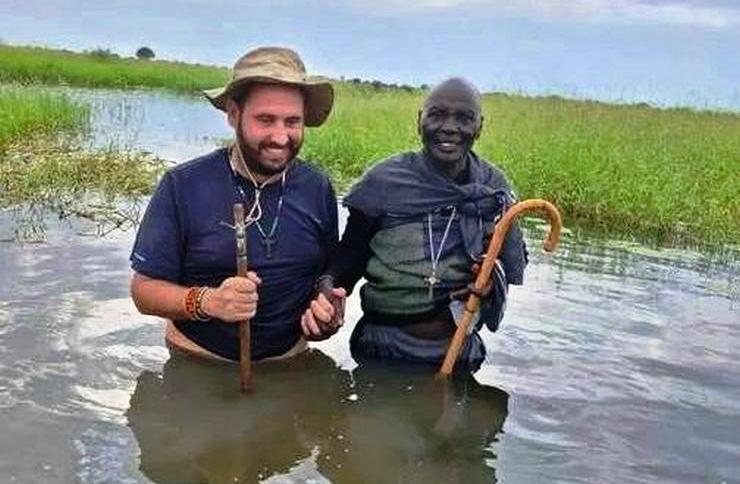
Today we live in a dangerous area of South Sudan called Leer, reachable only by World Food Program (WFP) helicopters. Here, people are experiencing severe famine; there are no adequate hospitals, and there is no electricity. During the rainy season, much of our mission territory turns into a vast swamp: we walk for miles through water and mud, often using canoes carved from palm trunks to reach the most remote communities. Some pastoral visits require days of travel.
Malaria continues to kill many children, and even the most basic medicines are often lacking. Yet, amidst this extreme poverty, the Nuer people continue to amaze with their dignity, their ability to share, and their unwavering faith.
The Nuer are a pastoral people. The cow is the centre of their lives: it provides milk, supports the family, represents wealth, and is used for as a marriage dowry. But bloody conflicts between different clans and ethnic groups are often rooted in livestock. Hatred and revenge fuel a spiral of violence that causes hundreds of deaths every year.
Education is also deeply affected by the war. In many areas, secondary schools do not exist, and teachers work without a real salary. In most schools, children study sitting on the floor or bringing a chair from home if they have one. Many girls cannot attend school because they are forced to do housework or are married off at a very young age. Illiteracy remains high, and many young people flee to refugee camps in Juba, Kenya, or Uganda in the hope of an education.
Last year, we Comboni Missionaries opened a secondary school dedicated to St. Daniel Comboni to help our people realize their dream of education. We also offered scholarships to help some young people attend university in South Sudan’s capital, Juba. The Gospel continues to generate hope and build life where the future seems to hold nothing worthwhile.
We missionaries are called, first and foremost, to proclaim peace amid this situation of violence stemming from a war caused by the corruption and thirst for power of a few who are unconcerned that thousands of people are killed every year because of their greed. We seek to be a presence of reconciliation in a land wounded by hatred and revenge. We walk with the people, share their suffering, listen to their cry. We visit the most remote communities to proclaim that God has not forgotten his people.
Here, Jesus is called “Kuär malä,” the “Lord of Peace.” It is a beautiful name. In the midst of war, hunger, and fear, people continue to believe that God is near. They continue to pray. They continue to hope. And it is precisely the poor people who evangelize us missionaries. In their faces, we discover God’s tenderness. In their ability to share the little they possess; we see the Gospel lived radically.
Truly, the people do evangelize us, showing us God’s tenderness for us. It is indeed true that the poor are our teachers who show us the face of God (Mt 25:31-46). It is really a great joy to accompany these people. The poor really do become teachers of faith. They teach us that Christian hope is not a naive illusion, but the certainty that the risen Christ continues to walk with his crucified people.
This is why we continue our mission with stubborn hope. We continue to believe in the resurrection of South Sudan. We continue to proclaim that Emmanuel, God-with-us, never abandons his children. Even in the darkest nights, the Gospel remains a burning light. And no war can extinguish the power of God’s love. (Fr. Mario Pellegrino)