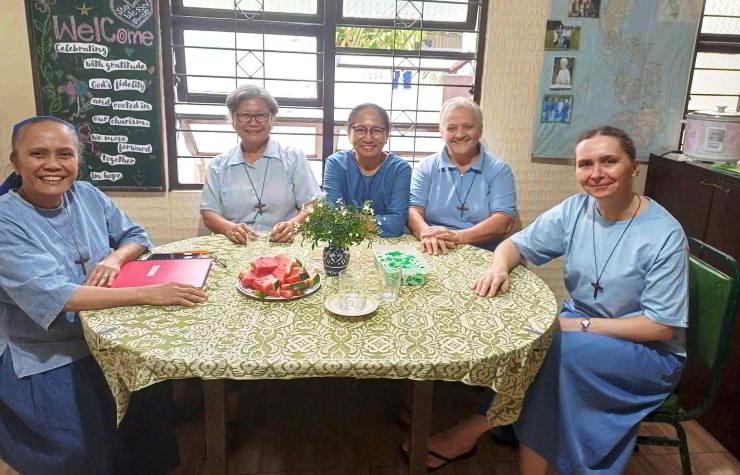
This year, the Little Sisters of Jesus, inspired by the spirituality of St. Charles de Foucauld celebrate 50 years of the presence in the Philippines.
These nuns have chosen an uncommon path. For five decades in the Philippines, their core charism is to be “contemplative in the middle of the world,” living a deeply prayerful life while remaining immersed in the daily realities of ordinary people, especially the poor and marginalized.
In the mid-1970s, in what was then a working-class stretch of Mandaluyong, located directly east of Manila, lined with factories and other labour environments, a small group of Catholic sisters went looking for jobs. They were not applying to teach in schools or administer hospitals. They were looking for factory work and other working-class jobs.
One sister found employment in a bubble gum factory. Another sister worked in a semiconductor plant. A Japanese sister cleaned hospital floors as a janitress.
They wore their religious habits when they applied. “At that time, it was unheard of,” recalled Sr. Cecilia Grace of Jesus. “People did not know that there were sisters who worked.”
In the early years, opportunities for more stable or prestigious work were offered to them. One prominent lay leader even proposed a high-ranking position. The sisters declined. “We explained that we don’t take jobs like that,” Sr. Cecilia Grace recalled.
Their vocation, she said, was not to lead institutions but to share the daily life of workers. The decision puzzled some. Why refuse advancement? Why choose factory floors over offices? For the sisters, the answer lay in Nazareth in accompanying people not from above, but from beside.
The congregation is the Little Sisters of Jesus, inspired by the spirituality of St. Charles de Foucauld – a spirituality rooted in Nazareth: hiddenness, manual labour, and quiet presence among ordinary people.
In 2026, they mark 50 years in the Philippines. If asked to describe their charism in one word, Sr. Maria Elizabeth of Jesus answered simply: “Unity.” But that unity has been forged not in convent seclusion, but in factories, rice fields, bakeries, slum communities–and sometimes under suspicion.
The Little Sisters of Jesus live on their salaries. Their constitution requires them to earn their own living. What they receive goes into a common fund. They do not own personally. “We are weak more than we are poor,” said Sr. Annarita of Jesus, an Italian who arrived in the country in 1991. Finding work has not always been easy.
During the political unrest under President Ferdinand Marcos Sr., sisters wearing habits were sometimes associated with religious groups who joined protests. Applying for manual labour while visibly a nun created confusion – and occasionally resistance.
Once, Sr. Cecilia Grace worked as a street sweeper at the Quezon Memorial Circle. “A security guard asked me, ‘Sister, why do you need to do this? You’re a nun.’ I told him Jesus was a carpenter, a simple worker. He answered, ‘Where is that in the Bible, Sister?’” she recalled, laughing.
The question lingered. For the sisters, the hidden years of Jesus in Nazareth – the long stretch of ordinary work before public ministry – are not incidental details in the Gospel. They are central.
In island of Masbate, Sr. Frances Grace of Jesus had continued that tradition. At 56, she is the only sister among the four who is still capable of employment by age. She worked eight-hour shifts in a bakery–weighing sugar in the morning, repacking biscuits in the afternoon. Now, she lives in their community in Mandaluyong. “It’s a very good way of being with the workers,” she said.
Often, the most important part of her day happens during short breaks. “Someone will approach me and say, ‘Sister, I want to talk to you.’” Sr. Frances Grace listens. “Just a listening heart,” she said. “At the end they tell me, Sayo ko lang yan nasabi. Ang gaan na ng pakiramdam ko.” (I just told you that. I feel so relieved). That, she believes, is already mission.
Years earlier, in garment factories and other workplaces, the same pattern unfolded. Co-workers shared burdens during lunch breaks–family struggles, financial anxieties, quiet griefs. The sisters did not preach. They stayed and accompanied them. “Our life,” Sr. Maria Elizabeth explained, “is being more than doing.”
In a culture that often measures worth by productivity, upward mobility, and overseas employment, their choice appears counterintuitive. Why descend when you could ascend? Why return to manual labour after education? Pinag-aral kita, tapos maggagapas ka lang? (I taught you, then you just mow?). Sr. Maria Elizabeth’s father told her. I educated you, and you will just harvest rice? The sisters respond not with argument, but with fidelity to the ordinary.
When the sisters discern where to live, they often choose communities with weak or absent church presence–working-class districts, rural villages, slum areas, remote farms. In the early 1990s, they moved into a squatter area in Diliman, Quezon City. There were no malls yet, no established parish structures.
Water had to be fetched at four in the morning. Neighbours sometimes offered to let them skip the line. They refused. “If you let people help you,” Sr. Annarita said, “it makes people equal.” When factory jobs were scarce, they washed clothes alongside neighbourhood women. “When we started doing laundry,” Sr. Annarita recalled, “our neighbour said, ‘Sister, you are really like us. You also need money.’ That helped people understand our charism.”
Today, the congregation in the Philippines is small and aging. “We see our littleness,” Sr. Maria Elizabeth reflected during their jubilee year. “We are fragile. But we have many relationships. That is our thanksgiving.” In their modest house in Mandaluyong, the door remains open. Homeless men knock and are welcomed to eat. Friends from different faiths come quietly to pray. A man who once pushed a cart collecting leftover rice for pigs became a regular visitor and friend.
Hospitality is not a program. It is simply their life. “We do nothing extraordinary,” Sr. Frances Grace said. “But God is alive in the ordinary. While I see His presence in our everyday life, my life as a nun is alive.” If the Little Sisters of Jesus carry hope beyond their 50th year in the Philippines, it is not for expansion or visibility. It is quieter than that. It is the hope that someone, somewhere, might discover that such a life remains possible–a life deeply rooted in God and deeply rooted in the life of people. Like Nazareth itself, small and easily overlooked, it does not call attention to itself. But it endures. (Oliver Samson)