Mauritania’s historic oases, founded between the 11th and 12th centuries, preserve a glorious past, yet are increasingly vulnerable. With libraries, stone cities, and modern dreams, these desert outposts resist abandonment, braving wind, sand, and isolation. But time is running out, and the future remains to be written.
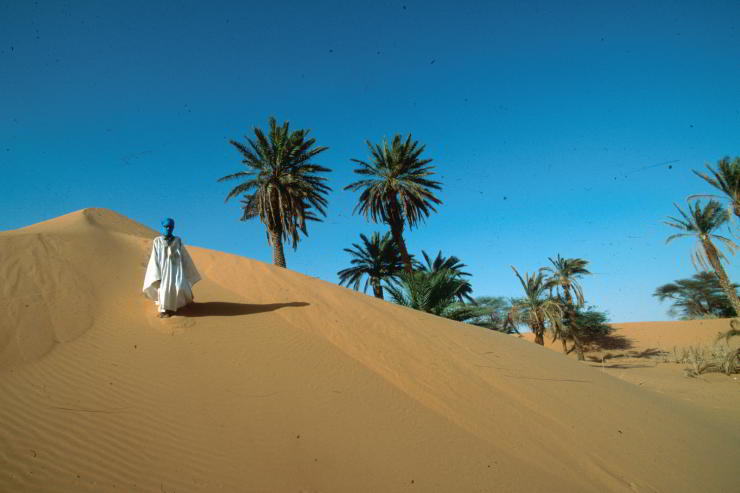
A relentless struggle against water, wind, and sand: this is the condition of Mauritania’s oasis villages today, far different from what they must have been like back in the 11th century, when they were founded. Oases in the desert, forgotten, gleaming beneath the sun that daily forces men, animals, and plants to protect themselves and escape the aridity of the great Sahara.
In a desert that tolerates no mistakes and punishes those who fail to tread its paths with respect, oases have always been synonymous with refuge and life. The Mauritanian desert is a hostile biome, far removed from the sinuous dunes of Niger or the ergs of Algeria.
Its landscape is shaped by wind and water, which together have sculpted its morphology. In this context, oases become indispensable strongholds, not only for travellers of yesterday and today, but also for merchants and caravans.
The Mauritanian territory has always been rich in minerals – copper, phosphates, silver, gold, even diamonds – but it was precisely the presence of oases that made trade possible, serving as landmarks, refreshment, and protection, true safe havens for the courageous Saharan trade, consisting not only of precious goods but also of ideas.
Small communities arose through family and personal ties, true pillars of the development of relatively closed societies, isolated from one another by hundreds of kilometres but united by a common destiny.
Four surviving historic cities, founded between the 11th and 12th centuries and still inhabited, are Ouadane and Chinguetti in the Adrar region, and Tichitt and Oualata in the Tagant. Between these two regions lie hundreds of kilometres of sand; plateaus and dunes separate Ouadane from Oualata for over a thousand kilometres.
Each city has unique characteristics: Ouadane is the stone city, built with a manuscript preserved in Chinguetti, the historic sanctuary city of the Sahara, known for its rich libraries of rare texts and precious slabs carved from the rocks of the plateau on which it stands, still cut by hand today.
Chinguetti has always struggled with the desert to avoid being swallowed up by the sands: its inhabitants have already rebuilt the town three times to save it, in an unequal battle with the Sahara. Oualata is known as the city of lace for the decorations of its private homes, while Tichitt, also built of stone, stands out for its ornamental motifs and its extraordinary prehistoric site, one of the most important in the country, extending for 18 kilometres.
These outposts along the trans-Saharan trade routes flourished in the Middle Ages, becoming centres of material and cultural wealth. The libraries saved from French colonial invasion and the numerous mosques bear witness to ancient wisdom and a profound religiosity: Chinguetti became a holy city of Islam, Ouadane the first university seat in the region.
Who founded these cities? It is important to remember that modern-day Mauritania was part of the great Ghana Empire, the golden empire that bordered the Mediterranean countries to the north. A crossroads of trade and opportunity, the Berbers quickly seized upon. But not only them: a few hundred kilometres from Ouadane lie the remains of the outpost built by the Portuguese in 1487 to control trade.
Seeing it today, abandoned and far from the sea, it seems incredible that it could have been so important. The voices of merchants and the clinking of coins can no longer be heard: everything is muffled by the silence of the desert. Yet, the extraordinary carpet of pottery testifies to the presence of jars and vessels used to transport goods or store water, essential after long crossings.
The southern part of Mauritania belonged, as mentioned, to the powerful Ghana Empire, which flourished from the 4th to the 11th centuries. Its extraordinary wealth allowed the birth of important cities, which still bear witness to that glorious past today.
While Timbuktu is known to all, Aoudaghost is almost unknown, yet it was the capital first of the Ghana Empire and then of the Mali Empire. Its ruins, which can be visited today, require a stretch of the imagination to recognize it as one of the great cities of the Sahel.
As early as 1154, the geographer al-Idrisi wrote: “This is a small city in the desert, with little water… Its population is not numerous and there is little trade. The inhabitants’ camels are their sustenance.” By that time, the city had already lost control of the salt trade. Indeed, despite not having gold mines, the Ghana Empire was extremely rich in the precious metal, which it exchanged with the Berbers for salt.
At the beginning of the 13th century, Oualata, 360 kilometres to the east, replaced Aoudaghost as the main hub of the caravan routes. Another oasis, now abandoned, also in the south of the country, is Koumbi Saleh. Here too, the ruins only hint at the city’s grandeur when it was the capital of the empires of Ghana and Mali, sharing the fate of Aoudaghost.
Today, it’s difficult to imagine the Sahara as a crossroads of trade routes, yet so it was. This is demonstrated not only by documents and cities, but also by ideas that moved alongside men, animals, and merchandise: the decorations of the houses in Oualata recall those of Ghadames, Libya, and northern Sudan. The same type of slippers typical of Ghadames are found in Oualata.
The Mauritanian desert is dotted with small villages where life flows slowly, governed by ancestral gestures, between nomadism and daily toil. Stopping for a simple photo of a smiling child, a woman wrapped in her veils, or a man in his boubou is not enough.
Only by pausing a little longer do we understand the harshness of life, the effort of going to the well, the importance of school, the time dedicated to tea, a sacred moment of sharing, and the five daily prayers that punctuate the day. It is not an easy life, but the people are hospitable, instilling trust and serenity. The children smile, and in their dark eyes shines a hope: that the splendour of the past can, somehow, return to illuminate the future. (Oriana Dal Bosco/Africa)