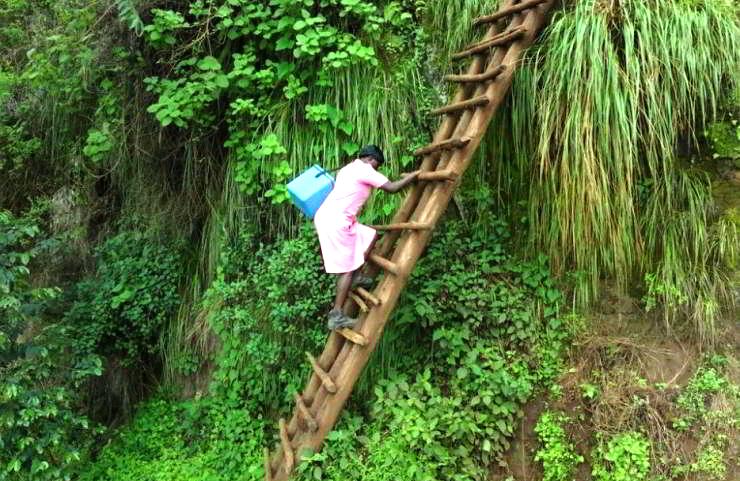
Every day at dawn, Agnes Nambozo climbs Mount Elgon via a precarious 300-meter log staircase to reach isolated villages. With a backpack full of vaccines and medicines, she treats dozens of people daily – especially children – bringing care to places that seem impossible to reach.
At dawn, before the sun has even cleared the slopes of Mount Elgon in eastern Uganda, a woman in a pink uniform closes her front door and begins her shift. She is Agnes Nambozo, a 34-year-old nurse, and her day with patients starts before six o’clock.
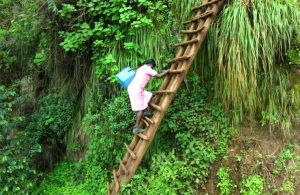
Taxis, motorcycles, high-altitude mud, and finally a staircase made of logs and ropes stretching nearly 300 meters – this is the only route connecting the Buluganya dispensary to the villages clinging to the volcanic rock faces. It is a four-and-a-half-hour journey to reach communities that, without her, would be cut off from all healthcare services.
The scene has played out for years: Agnes, her thermal backpack filled with vaccines and medicines, and the mountain ahead. “I have no problem climbing up here,” she says. “I know these people have the same right to health as anyone else. That is why I keep coming back, every day.” Her motto is the same as that of thousands of Ugandan nurses: to love and to serve. But for her, love is not an abstract feeling; it is action – step by step, rung by rung.
The log staircase – built by the community – is too steep for mothers with newborns, the elderly, and the sick. It means that without Agnes, reaching a doctor or completing a course of vaccinations would be impossible.
“Before she came here,” says Ruth Wanyenze, a mother of four, “we had to walk down to Zema – a journey that took hours. Sometimes our children wouldn’t finish their vaccinations because the trek was too difficult.” Now, however, healthcare comes to them.
Each workday is a minor logistical operation. Agnes arrives at the dispensary around eight o’clock, prepares her supplies, puts on her refrigerated backpack, and sets off by motorcycle for the “gateway” to the mountain. Then the climb begins. By around 10:30 a.m., when she opens her vaccine kit on a wooden bench, she has already been on duty for nearly five hours.
On average, she attends to about fifty people a day – mostly children under five – treating conditions like polio, measles, tetanus, and pneumonia. These are diseases that seem to belong to the past elsewhere, but are a hazard of daily life here.
In these remote communities, Agnes is more than just a skilled nurse; she is an unsung hero saving hundreds of lives every month. She distributes vaccines and vitamins, conducts prenatal check-ups, monitors suspected tuberculosis cases, and delivers medication to HIV patients unable to reach the valley. She answers questions, educates on prevention, and brings medical care to places it would otherwise never reach.
A nurse’s work in Uganda is often very hard, but it is crucial to the country’s healthcare progress. In 2000, child mortality was staggering: 145 deaths for every 1,000 live births. Twenty-five years later, that figure has dropped below 40.
It is a historic transformation made possible not only by public investment and international programs but, above all, by thousands of healthcare workers reaching forgotten communities. Among them are women like Agnes.
Today, however, Uganda’s healthcare system faces a new challenge. Cuts to USAID funding have left many districts short-staffed. At the Buluganya dispensary, dozens of Agnes’s colleagues have lost their jobs – workers dedicated to maternal and child health services, HIV treatment distribution, and the fight against tuberculosis. “The community is suffering greatly,” she admits. “We try to carry on with what remains, but the pressure is immense. The risk of burnout is a daily reality.”
However, Agnes does not stop working; she even continues with her studies. Thanks to support from the Rotary Club of Kampala, she is pursuing a university degree in nursing. She wants to acquire new skills “to save even more lives.” It is not merely a professional goal but a personal dream: to provide a future and dignity to those living in places the state struggles to reach.
As the sun is setting behind the ridge, Agnes fills her backpack, says goodbye to the village mothers, and begins the descent into the valley. She has spent her day using syringes, consulting medical records, and the shy smiles of children who, for the first time, hold a complete vaccination record.
Tomorrow she will return, with the same steady pace and the same tenacity. Anyone looking at that path clinging to the steep incline might wonder how she faces it every day. Agnes answers without fanfare, with the simplicity of someone who has chosen the harder path: “When you do the right thing, nothing is impossible.” (Stefano Pancera/Africa) – (Photo: Bill Gate Foundation)