The Sanctuary of Our Lady of the Rosary of Chiquinquirá, in Colombia, is home to the country’s patroness. The current basilica, built in the 19th century, is a major pilgrimage destination for Colombians and devotees from neighbouring nations.
The Marian Sanctuary of Our Lady of Chiquinquirá is located in this small town on the banks of the Suárez River in Colombia. Yet, it has become renowned as the nation’s religious capital. Its name, in the language of the indigenous Chibcha people, means ‘priestly people.’ Indeed, the town’s inhabitants have witnessed countless graces granted by Mary to the Colombian people, who have been afflicted by bloody wars and serious diseases.
Thirty-six years had passed since Spanish navigators first landed on the American continent when nineteen Dominican friars arrived in the city of Santa Marta, in northern Colombia, in December 1528. These friars were devoted to Our Lady and brought with them a statue of the Virgin of the Rosary.
It was the first statue of the Virgin in this South American country. Twenty-eight years later, the statue arrived in Santa Fe, in the centre of the country, where it was accorded great honour. Furthermore, devotion to Our Lady was becoming the driving force behind missionary preaching and the growth of the Church in Colombia.
Thus, quite naturally, when Antonio de Santana was appointed administrator of the settlements of Suta and Chiquinquirá, he asked the Dominican friar Andrés Jadraque for an image of the Virgin Mary to place in his private chapel in Suta. The friar then commissioned the Spanish painter Alonso Narváez to create a copy of the statue.
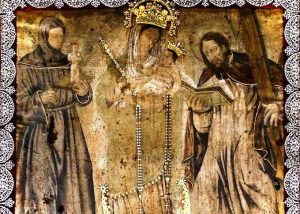
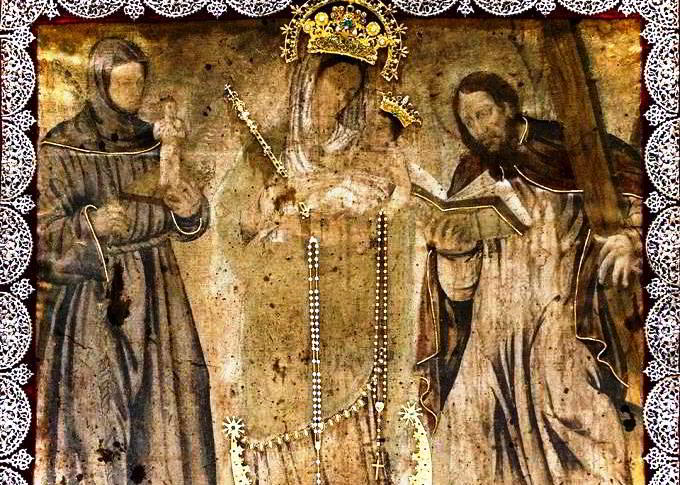
The painter depicted the sacred image on a cotton canvas woven by the indigenous people, using colours made from mixing earth and the juices of flowers and herbs. The Virgin Mary wears a gentle smile. She is dressed in a pale pink tunic and a sky-blue mantle. A white veil covers her head and drapes down over her chest. She holds the Infant Jesus in her left arm and clutches a sceptre in her right hand. Beside her, Alonso Narváez painted Saint Anthony of Lisbon on the right and Saint Andrew the Apostle on the left. Upon its completion in 1563, the work was displayed on the altar of the Suta chapel for the veneration of both Spaniards and indigenous people.
It was in that thatched chapel that Friar Andrés catechized the region’s indigenous inhabitants. Eleven years later, the mission – which had been entrusted to the Dominicans – passed into the care of the diocesan clergy, and Friar Andrés Jadraque was sent to another convent.
Coincidentally, devotion to the image waned, and it was abandoned. Over time, the chapel fell into disrepair; the sun and the elements damaged the canvas, which was eventually removed and ended up in the storeroom of a country house. It was there, in 1585, that a woman named María Ramos discovered the abandoned canvas.
Knowing that an image of the Virgin was painted upon it, she recited the following prayer: “How long, Rose of Heaven, will you remain so hidden? When will the day come for You to reveal and show Yourself, so that my eyes may delight in Your sovereign beauty, which fills my soul with pleasure and joy? Then, Rose of Heaven, You shall be as You are meant to be: beautiful as a rose.”
These words, which María Ramos repeated daily, had a miraculous effect; indeed, on Friday, December 26, 1586, a wondrous event occurred. At nine in the morning, the devout woman rose to leave the chapel after praying for more than two hours. At that moment, an indigenous woman named Isabel, originally from Muzo, passed by with a four- or five- year-old child.
As they passed the chapel door, the child said to the woman holding him: “Look, look!” The woman looked toward the chapel and saw the image of the Madonna standing on the ground, radiating a light that filled the entire chapel with a brilliant glow. Filled with amazement, she said to María Ramos, who was leaving the oratory: “Look, look! The Mother of God has risen from her place, and it looks as if she is burning.”
María Ramos looked and, astonished by this wondrous miracle, approached the image with deep emotion and knelt. Miraculously, the entire painting had been completely restored, save for the holes it had previously borne, which remained on the canvas. With great reverence, the two women returned the painting to its place. The face of Our Lady of the Rosary remained radiant throughout the day and took on the features that can still be admired today.
News of the miracle spread rapidly throughout the surrounding area, and the inhabitants hastened to see the renewed image, driven by curiosity or the hope of obtaining miracles. Accounts from the time state that many people were healed. One story recounted that, during those days, an epidemic of plague broke out in Tunja. A delegation travelled to Chiquinquirá to bring the painting there for a few days. The image remained in Tunja, and the plague was eradicated.
In Chiquinquirá, the image was housed in a dilapidated, doorless hut. Father Figueredo, who was in the region, called upon the local indigenous leader and asked him to build a chapel worthy of housing the Sacred Image. Within five months, the indigenous people built the chapel and transferred the image there.
In 1587, the Archbishop of Santa Fe de Bogotá gathered sworn testimony regarding miracles granted by the Virgin of the Rosary of Chiquinquirá and ordered the construction of a church. Work began the following year, and the first church – built of stone and brick – measured 150 meters in length and 38 meters in width. In 1596, Pope Clement VIII granted a plenary indulgence to anyone who visited the sacred image of the Virgin with devotion.
Two centuries later, a larger sanctuary was built and consecrated on September 11, 1823. With a decree dated July 18, 1829, Pope Pius VII declared the Virgin of the Rosary of Chiquinquirá the Patroness of Colombia. During the Thousand Days’ War (1899–1902) – a bloody civil war – Colombians implored the Virgin of the Rosary to grant them the peace they so deeply desired. At the war’s end, a petition was sent to Pope Leo XIII requesting the coronation of the Virgin of Chiquinquirá. Pope Saint Pius X granted the request on January 9, 1910.
The painting of Our Lady of the Rosary of Chiquinquirá was canonically crowned on July 9, 1919, in the Cathedral of Bogotá. In 1927, Pope Pius XI granted this Marian sanctuary the title and privileges of a minor basilica. Saint John Paul II visited Colombia in 1986 and, on that occasion, made a pilgrimage to the shrine.
Devotion to her spread from Colombia throughout Latin America. July 9 and December 29 are dates dedicated to the Virgin of the Rosary of Chiquinquirá, and thousands of the faithful travel to the shrine from across the country and neighbouring nations. (The first and original painting was made by the Spaniard Alonso de Narváe on cotton support in 1562)