He will be ordained a priest in December. However, beforehand, James Komakech decided to visit a Catholic community in the vast Haat region, which is located in the wet and remote Ayod County area of South Sudan. Here, he shares his 12-day experience with us.
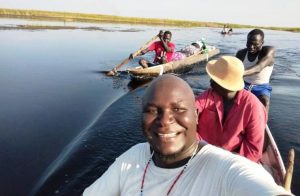
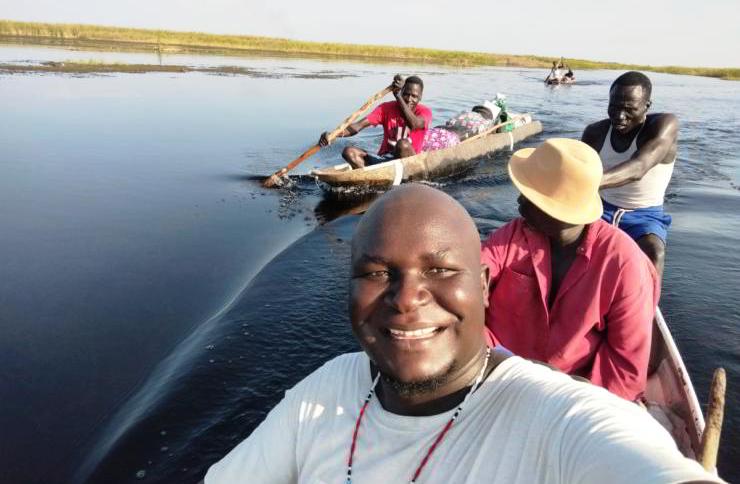
We set out with Musa Gatjang, our eldest catechist and the vice-chairperson of the parish council. Our three-day journey from Paguir, the current parish headquarters, to the Haat region was made by traditional canoe. Accompanying us were Stephen Kueth and James Leer Gai, who are from the Haat region, as well as Peter Buoth and James Ruot, who are the head catechists at the two main centres in the area: Diit and Haat.
Travelling by local canoe through the vast waters for hours on end was an adventure in itself. We saw crocodiles, monitor lizards, hippos and countless species of fish, both large and small. Our experienced boatmen knew exactly how to navigate the strong currents of the White Nile. They could also often identify the animals moving through the water near us.
We spent our first night at the St Peter and Paul’s Chapel in the Toch Centre. The following day, we moved on to Gangnyang Chapel under the Nyadin Centre, where we slept. On Sunday, we celebrated a beautiful liturgy with the small local community.
That afternoon, we continued our journey and spent the night with another Catholic community in Kotjaths. We resumed our navigation at 3 a.m. and reached the Haat region, arriving at St Peter’s Chapel in Menime Pomb around midday. This long journey served as a reminder of the geographical challenges these communities face, as well as the determination and faith that sustain them.
The following day, I baptised four children and blessed the newly built, grass-thatched church at St Peter’s Chapel in Menime Pomb. The day after that, at St Mary’s Chapel in Lingiri, I baptised another sixteen children and blessed the new chapel.
Members of the local Presbyterian Church joined us in an enriching ecumenical prayer, expressing the spirit of Christian unity and fraternity.
We continued our journey by canoe to the St Peter and Paul Chapel in Pakuem under the Diit Centre. There, we met men, women and young people who had gathered from various centres and chapels for a vibrant celebration filled with traditional dancing, drumming, singing and joyful expressions of faith. During the celebration, 77 children and adults were baptised.
The pastoral programme also included practical activities designed to strengthen community life. For example, the women’s group learned how to produce multipurpose liquid soap, and the Com-Maria group learned how to make missionary rosaries using materials that I had brought with me.
On Sunday, I blessed the newly built St Peter and St Paul thatched chapel in Pakuem and presided over the Sunday liturgy. In the afternoon, beside the river and surrounded by lush greenery, we recorded six Catholic songs in the Nuer language, performed by the local youth choir.
Wearing colourful outfits, the choir sang with great enthusiasm, accompanied by traditional drums and joyful ululations that echoed throughout the village. There was no electronic keyboard. The choir uses traditional instruments to make celebrations vibrant and culturally rich.
The large congregations that gathered for the celebrations and 97 baptisms are a powerful sign of hope, demonstrating the continued growth of the Catholic Church in this remote region, despite the absence of a priest or deacon.
Despite the ongoing political crisis and widespread flooding in South Sudan, the people of this region remain rich in faith, hospitality, resilience and love. Although they may only see a missionary once a year due to the great distances involved, their Christian communities remain well organised and strong in faith.
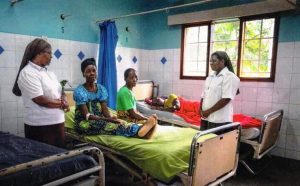
In the absence of an ordained minister, catechists lead prayers, organise catechesis and collaborate with the local church committees to sustain community life. This commitment reflects Comboni’s vision of empowering local people to take the lead in their own evangelisation and development. However, I also saw that access to schools and hospitals remains a major challenge.
For me, the experience was more than an ordinary pastoral visit; it was a journey of faith, hope and solidarity. For many people, it was their first encounter with a South Sudanese Comboni missionary. Their joy and enthusiasm touched me deeply. I was enriched by their hospitality, resilience, and generosity.
A few days later, we returned to the parish centre. From there, I continued my journey to my home parish, where I will be ordained a priest on 8 December in Lomin, Kajo-Keji County, close to the border with Uganda. I will be the first Comboni missionary from my parish. The parish was established in 1985. As I prepare for my ordination, I carry with me the faith, prayers and hopes of the people of Haat.