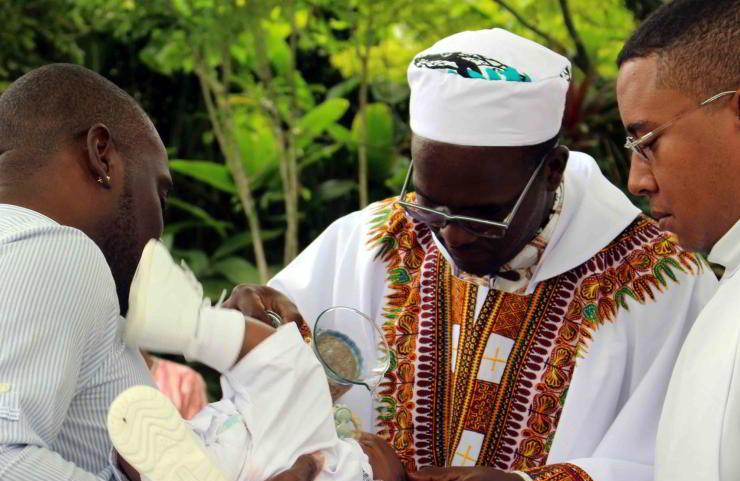
An African pastoral care worker’s primary mission is to tell people of African descent that God loves them in a context of social coexistence where violence, mistreatment, discrimination in all spheres, injustice in all its forms, and the invisibility of their being… are daily bread for them, their families, and their communities.
This mission requires the Afro-pastoral worker to answer the following questions: How can we tell the descendant of an African slave that God loves him? How can we help him identify this in his own history and in the reality he inhabits? How can we interpret his history as a sacred and salvific story? How can we help him see and understand God from his own culture?
The mission of the Afro-pastoral worker is therefore to theologically interpret the history and reality of the Afro-descendant, together with him and his community, so that he can reconstruct his identity starting from the Creator and embrace, individually and communally, His transformative presence in the context in which he finds himself. A theological reading of history and reality means understanding them starting from God, from His presence in them, from His liberating and salvific will. For this reason, theology is fundamental in the training of the Afro-pastoral worker.
In the Western world, theology, in general, serves to “explain” the Creator to people; that is, it has an intellectual approach. But for our peoples of African origin, an “explanation” of Him, of His existence, isn’t important… because they’re already convinced of it; for them, the question is whether He is their Father or not, whether He loves them like children or not, whether He is happy and satisfied with them or not, whether He is with them or has abandoned them to their fate… Theology, in this sense, isn’t just a “discourse on God,” but an experience of Him, a way of living Him.
For this reason, it’s essential to recover and communicate the experience that people of African descent have of God, both individually and collectively. And, with this experience, reconstruct the divine image, beginning with the specific cultural and spiritual traits inherited from Africa. Some of the first “theologians of the Church” were African.
Among them was Tertullian (154-224), originally from Carthage, North Africa. He proposed and defended a popular Church that had little to do with philosophy, but with the concrete experience of the people. A faith that encounters the Father in the reality we live and resolves life’s questions together with his people beyond the temple. We could say that this is an African way of seeing and understanding, because it is an African who makes us see God in this way.
Respecting the spiritual experience of Afro-descendants, embracing it, contemplating it, understanding it… and discovering how the Creator is present in it, is the first step in the theological journey that every Afro pastoral care worker must undertake in their community.
Accompanying this experience, which people of African descent share, is essential to its discovery in their lives, because for African peoples, “religion” is closely linked to daily life in all spheres: personal, family, social, political… This is why God is invoked everywhere and at all times to receive the strength of his Spirit and thus be able to face adversity.
In Africa, drumming and dance are the means of invoking and sensing the presence of the Spirit and his transformative power, which begins with community organisation. Therefore, in order for the experience of God in our peoples of African descent to not only be strengthened but also become a transformative force for the Church and society, it is crucial not to ignore this symbolic reality of dance and drumming as the path through which He descends to live with His African people, to listen to their problems, their hopes, and to seek solutions together.
Listening to God around the fire, as a family, as friends… without the need for a temple, but only with the awareness of His sacred presence among us, makes the place where we converse with Him a sacred place and a revelation of His will.
A place from which He speaks to the Church, to society, to the world… Remembering and recovering these African experiences will ensure that our presence is not merely a “discourse on God,” without a specific face or colour. It will make us a living Afro-theology in the Church and society; that is, we will be people who speak of the Creator from a theological place called “Africa.” (Lucía Rivera) – (Photo MC)