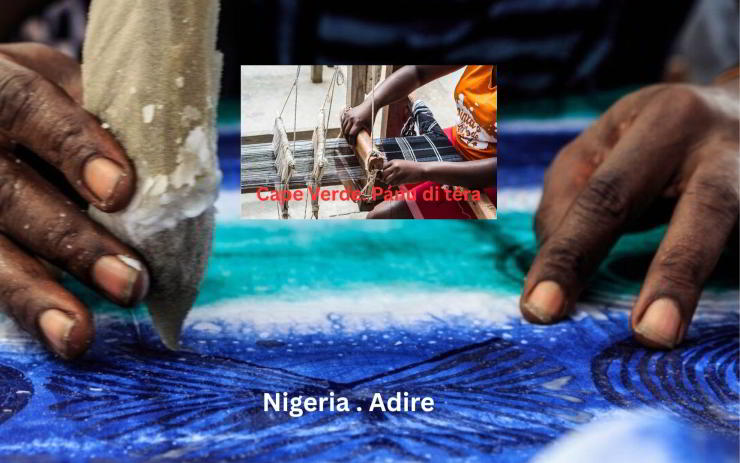
Today, we take you to Nigeria to discover a cotton cloth dyed using a technique common among the Yoruba people: adire.
Fabrics made using the original dyeing methods still survive in the country’s markets today, despite the textile industry being undermined by cheaper dyes imported from China.
Adire fabric is made by Nigerian women using the tie-dye technique. This involves folding the fabric, tying it, and hand-sewing it in specific ways and at particular places before immersing it in natural dyes. The result is a variety of patterns, from simple to complex.
Each design is not random, but rather embodies stories, symbols, or concepts related to a spiritual dimension. Traditional methods include tying raffia around the fabric, a process known as àdìrẹ oniko. This tying is responsible for a wide variety of patterns. Other methods also involve tying small stones or seeds into the fabric to create small circles.
The fabric is used to make traditional clothing worn by Nigerians for special occasions, weddings, and celebrations. The term àdìrẹ, meaning “tie and dye” in Yoruba, was first used in the early 20th century. Typically, two pieces of fabric were sewn together to make a woman’s dress.
Traditionally entrusted to women, the process of making adire fabric involves two dyers called “alaro,” who are responsible for the production and marketing of the fabric, and decorators called “aladire.” Basic techniques are used to create white lines and designs that stand out against a very saturated indigo blue background.
The southwestern city of Abeokuta is still known as the capital of Adire, a hub and home to nearly 2,000 traders and producers. But in recent years, producers and traders of this fabric have been in crisis. The main problem appears to be Chinese competition, which produces large quantities of cloth using machines, rather than following the traditional handmade method.
It’s not just competition that is hindering traditional production. People are buying fewer traditional fabrics in favour of cheaper alternatives due to the cost of living, which has risen sharply in Nigeria in recent years. (Photo: Courtesy of The Centenary Project)
At the origins of Cape Verde’s “Pánu di téra” (earth cloth), a blend of identity and culture
There is a fabric deeply intertwined with the history and identity of Cape Verde: it is called “Pánu di téra” (earth cloth), and was first produced in the country in the fifteenth century.
Over time, it has taken on different meanings, from a bridal or mourning cloth to a currency of exchange during colonisation, and finally to a symbol of regained independence.
Its origins date back to the fifteenth century, when it was introduced to Cape Verde by Guinean slave weavers who spread the technique and workmanship. It was later used as a trade currency for the acquisition of slaves from the west coast of Africa to be sold in Brazil.
Portugal then banned it in the twentieth century. The fabric was revived with independence in 1975, which is why it remains a key element in the collections of designers and artists who use it to enhance and celebrate their roots and Cape Verdean identity.
Its social use varied greatly but was tied to celebrations, for brides who wore it at weddings or for mourning, or even to swaddle newborn babies.
Tera cloth stands out from other African fabrics, which in themselves embody much of a country’s history and culture, for its fusion of complex geometric patterns and the influence of Islamic or Hispano-Moorish motifs in its weave.
The most common colours are white and blue, or the traditional black and white. Another distinguishing feature is the complexity of its workmanship. The fabric is composed of six strips of 100% cotton, and it takes a whole day to make one, and almost a week to complete a cloth. Consequently, tera cloth has always been costly.