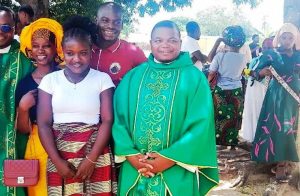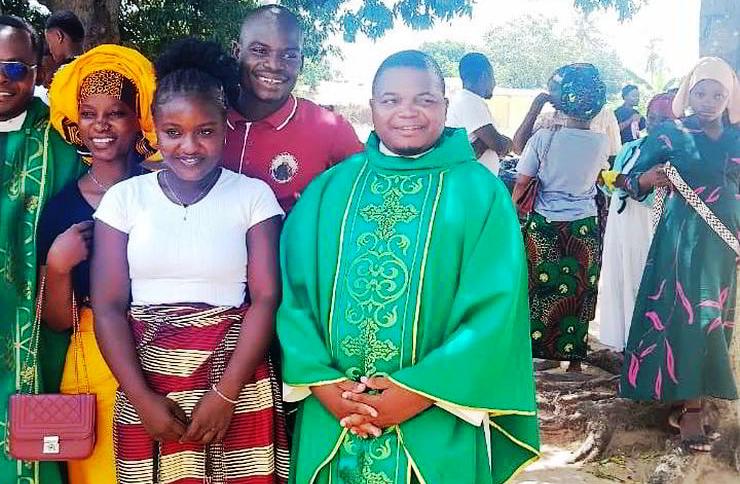
“From a young village boy who simply wanted to see a priest, I have become a Comboni missionary priest serving the people of God”. Father Emmanuel Likonye from Malawi shares with us the vocation journey.
I was born and raised in a Catholic family of five children. Growing up in humble conditions, I never imagined that I would one day become a Catholic priest. In our village, it was difficult to come across priests, nuns or other people who could inspire us to dream about our future. Such people rarely visited our community.
The word ‘priest’ first entered my mind through catechism classes, where the catechists often spoke about them. However, I did not understand what a priest was. Whenever I returned home, I would ask my parents, but they could not explain it to me clearly. Instead, they promised to show me when a priest visited our community church.
I simply wanted to see a priest; I had no desire to become one. One day, during Mass at our local church, a man arrived wearing a long white cassock with a black cincture around his waist. He carried a briefcase containing the items needed for the Mass and wore a Roman collar. Later, he put on sacred vestments, including a chasuble that covered him from neck to feet. This made the celebration different from the usual prayer services we attended.
At the end of the celebration, I heard the church leader refer to him during the Mass. What surprised me most was hearing people call him ‘Father’, which only increased my curiosity. One evening, while sitting with my parents at home, I finally found out what a priest was.
I joked, “I will become a priest who gives people the Eucharist and celebrates Mass. I will wear a chasuble like his.” That was how my dream of becoming a priest began.
I started seriously considering the priesthood when I was seven. This happened on the day I received the Sacrament of Confirmation in 1999. Seeing the bishop and the priests who accompanied him was a great inspiration to me. A few months later, I attended the ordination of a Comboni missionary priest in my home parish. These two events played a significant role in nurturing my desire to become a priest.
As I progressed through school, my dream remained alive. Whenever people asked me what I wanted to be when I grew up, I would quickly say that I wanted to be a priest. Although I did not fully understand what that vocation entailed, the answer came naturally to me.
However, as I grew older, my desire to become a priest gradually weakened. I did not experience any particular event or sign that made me feel that God was calling me. Instead, I was drawn to the opportunities and ambitions that the world seemed to offer. The priesthood seemed less appealing, and I began to think that life could be better spent pursuing other goals.
One day, seeing a copy of the Comboni Missionaries’ magazine New People, which a friend was holding, rekindled my desire to become a priest. The back page contained the contact details of vocation directors. My friend introduced me to the Comboni Missionaries, a congregation of which he was himself an aspirant. He encouraged me to write an application letter, but I repeatedly resisted.
Eventually, and without my knowledge or consent, he wrote a letter to the vocation promoter on my behalf. Fortunately, the letter received a response and I was invited to attend ‘Come and See’ meetings. When the invitation arrived, my friend told me that he wanted someone to accompany him to the meetings in Lunzu. At the Comboni Community in Lunzu, I met other young men who had come for the same reason. I found the experience enriching, and I felt welcomed by the group.
After secondary school, I hoped to become financially independent and stop relying on my parents. I planned to work, save money and eventually pursue a university education, all the while continuing to reflect on the priesthood.
Talking to my colleagues at work about my plans gave me the freedom to make an informed decision. Some encouraged me, while others tried to dissuade me. Similarly, when I told my parents and friends that I wanted to leave my job to become a missionary priest, many thought I was joking. This was not the future they had imagined for me.
To them, abandoning a job to dedicate years to studying philosophy and theology seemed like a loss. Few people believed that I would actually follow through with the decision. Nevertheless, I am grateful that my parents eventually respected and supported my choice.
My formation journey began with the postulancy in Balaka, Malawi, from 2014 to 2017, followed by the novitiate in Lusaka, Zambia, from 2017 to 2019. I then joined the Uganda Martyrs Scholasticate in Nairobi, Kenya, undertaking four years of theological studies and one year of pastoral ministry between 2019 and 2023.
I then spent a year in missionary service as a deacon in South Africa from 2023 to 2024. On 23 August 2024, I was ordained as a priest in Malawi. I now serve joyfully in Mozambique Province as a young missionary, continually thanking God for his faithfulness.
My journey towards the priesthood was marked by many difficulties. Coming from a poor family meant that obtaining even the most basic necessities was often a struggle, which impacted my education. My training also presented its own challenges. There were times when I was misunderstood and accused of things I had never done, and asked to take responsibility for others’ mistakes.
There were moments of hurt, disappointment and healing. Throughout this time, however, I never lost hope in God. Instead of discouraging me, these challenges became opportunities for personal growth and a closer relationship with Him.
Looking back, I can only thank God for his faithfulness throughout my vocational journey. I have gone from being a young village boy who simply wanted to see a priest to becoming a Comboni missionary priest serving the people of God.