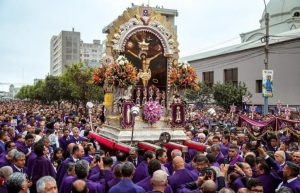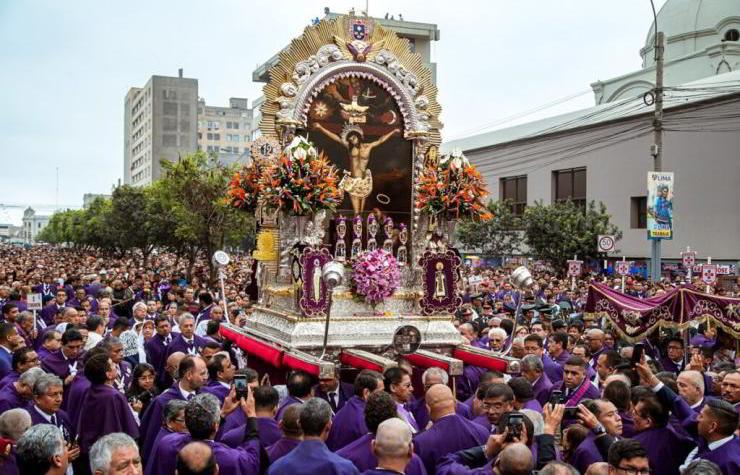
The Feast of the Lord of Miracles is Peru’s main religious celebration. It is celebrated in October, especially in the capital Lima. The processions of Cristo Morado (The Purple Christ) bring together thousands of faithful wearing purple robes or capes.
The veneration of a painting of the crucified Jesus Christ, called the Lord of Miracles, is one of Peru’s most important and representative religious traditions. Thousands of devotees from various regions of the country gather in Lima every year for an individual and communal experience that combines faith, history, and culture. This has become a symbol of Peruvian identity, as it is a national celebration uniting people of all social classes and regions through piety.
The veneration of the image of the Lord of Miracles dates back to 1650, when the territory was under Spanish colonial rule. Lima then had a population of 35,000, a number that grew with the arrival of thousands of people attracted by prosperity and wealth.
At the same time, Spain brought slaves from West Africa to Lima, classified by caste: Congos, Mandingas, Mondongos, Moçambiques, Terras Novas, Minas, and Angolas. The Angolans were the largest group of slaves and were brought to the Pachacamilla neighbourhood in 1651, where they settled and organized themselves. Among the huts, they also built rooms with images of saints, where they recited their prayers. These acts reminded them of their freedom, and they prayed and sang in their native language.
One group organized a brotherhood in the neighbourhood. On one of the adobe walls, an Angolan named Pedro Dalcón or “Benito”—according to Raúl Porras Barrenechea (1897-1960), a distinguished Peruvian lawyer, professor, historian, writer, diplomat, and politician—painted the image of Jesus on the cross in 1651.
The work was simple, yet charged with profound spirituality, as Christ was painted in purple. The slaves and inhabitants of the region began to gather to pray before the image of Christ with whom they identified. Later, in 1671, images of God the Father, the Mother of Jesus, Mary Magdalene, and the Holy Spirit were added, commissioned from the painter José de la Parra.
The first significant test of the strength of this devotion occurred on November 13, 1655, when a violent earthquake struck Lima. Much of the city collapsed, including churches and stone houses, but the fragile adobe wall on which the image of Christ was painted remained intact. The phenomenon was considered a miracle, and news spread, bringing ever more faithful to venerate the Christ of Pachacamilla.
They gathered on Friday evenings, bringing flowers, perfuming the air, and chanting prayers. In 1671, by order of the viceroy, a chapel was built, and the archbishop appointed four mayors to honour the religious cult, the most important of whom was Sebastián de Antuñano. On October 20, 1687, another powerful earthquake, followed by a tsunami, devastated Lima and the port of Callao.
Once again, the building housing the painting was severely damaged, but the wall with the Crucified Christ remained intact. Sebastián de Antuñano then requested a replica of the image of Christ on the wall to be painted on canvas. For the first time, the image was carried in procession through the city streets as an expression of gratitude and supplication for divine protection.
On October 28, 1746, when Lima was struck by one of the strongest earthquakes in its history, the population carried the replica of the image of the Lord of Miracles through the streets and alleys of the city. Thus was born the tradition that would become one of the largest Catholic processions in the world. And it is this very image that is still carried in procession today. Last October, during the Jubilee Year, the Great International Procession of Our Lord of Miracles passed through the streets of Rome and reached St. Peter’s Square, where Pope Leo XIV blessed it.
The image of the Lord of Miracles appears six times, on October 4, 18, 19, 26, and 28, and November 1. The chariot of the Lord of Miracles leaves the Sanctuary and Monastery of Nazarenas (built in 1771 on the site of the hermitage) and returns there. It is carried by 32 members of the Brotherhood of the Bearers of the Lord and has an oak stand. The silver adorning it alone weighs 450 kilos. The bearers obey the general foreman and a deputy foreman and are organised into teams, each with its own leader. There is also a brotherhood of incense burners and another of singers, who sing hymns and songs of praise and penance without musical accompaniment. A coordinator gives the order to stop and continue the procession.
All these people wear a purple cloak and tunic and a white cord. For devotees of the Lord of Miracles, the purple robe signifies identification with the pain and love of Christ, as well as gratitude for the miracles received. By wearing it, people express repentance, a desire for change, and a process of spiritual conversion.
It is common practice for devotees of the Lord of Miracles to wear purple robes throughout October. It is a way to reciprocate requests or promises made. Many faithful make a pilgrimage to the Church of the Nazarene, located in the centre of Lima, to pray before the original image and participate in the Eucharist. It is a moment of spiritual encounter.
In 2005, Peru’s Ministry of Culture declared the feast of the Lord of Miracles a National Cultural Heritage. That same year, the Vatican, in coordination with the Archdiocese of Lima, designated the Lord of Miracles, the Patron Saint of Peruvian Residents and Immigrants. Indeed, Peruvian emigrants also celebrate this cult during October, in cities around the world where they have settled, celebrating its religious, cultural, and gastronomic aspects. (Fernando Félix) – (Photo: Arzobispado de Lima)