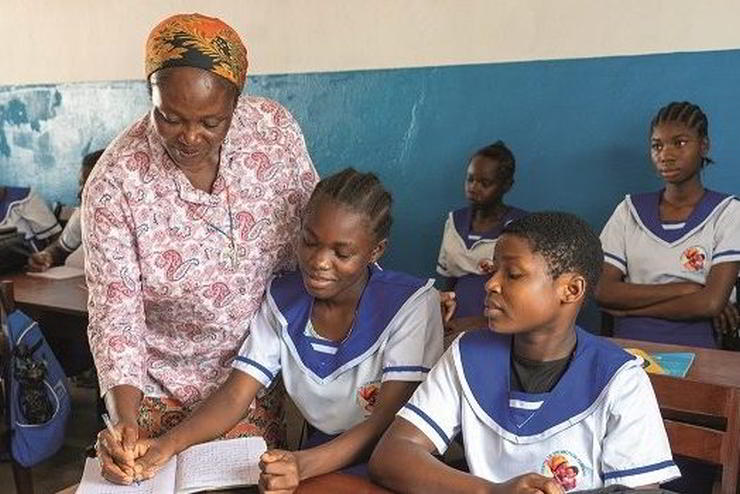
In the Central African Republic, girls face greater challenges than boys in completing their education. This situation prompted Sister Juliette Makolet, a Comboni missionary, to open the Saint Daniel Comboni Centre for the Advancement of Women in 2022. This facility supports adolescent mothers and vulnerable girls. We went to visit it.
The Saint Daniel Comboni Women’s Advancement Centre is located in Bimbo, an outlying district of Bangui, the capital of the Central African Republic. Upon passing through the gate, a spacious area opened up before us, featuring a single-story building made up of three classrooms and rooms for other purposes.
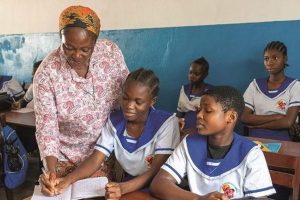
The young women are in class; almost all wear the centre’s blue-and-white uniform, complete with a sewn-on emblem. In one classroom, the students work to the rhythm of sewing machines, while in another, needle and thread in hand, they embroider pieces of fabric.
In yet another classroom, the teacher conducts a civics lesson, encouraging the young women to respect everyone – especially the elderly – and to practice simple gestures like greeting others and saying “good morning.” Sister Juliette Makolet, the centre’s director and founder, tells us: “These girls have suffered greatly. Many carry psychological wounds that affect their relationships with others. For this reason, we have a general supervisor responsible for ensuring order, cleanliness, and adherence to schedules. As for me, I try to provide personalized psychosocial support, adapting to each girl’s specific needs.”
Sister Juliette is the first Comboni Sister from the Central African Republic. She recounts: “My family always encouraged me to study, despite the patriarchal system prevailing in this country, where families consider it normal to send sons to school while keeping daughters at home to handle household chores.”
After years of missionary work in Dubai, Eritrea, Italy, and the Democratic Republic of the Congo, Sister Juliette returned to her home country in 2020 with the aim of doing something for girls who had not enjoyed the same opportunities she had.
In Bimbo, home to the Comboni Sisters’ community, Sister Juliette met many girls who had dropped out of school and were staying at home with no prospects for the future; most were teenage mothers in a country where early pregnancy is, unfortunately, a widespread issue. “Although girls in the Central African Republic are not expelled from school, they often withdraw voluntarily out of shame, preferring to stay at home,” Sister Juliette explains.
With the support of her fellow sisters in the congregation, Sister Juliette established the centre in a room within the Comboni community complex, starting with a small group of 25 girls. However, requests kept coming in, and not all the girls could be admitted due to a lack of space. Consequently, the Comboni Sisters decided to purchase a property and relocate the centre there, managing to triple its capacity and accommodate over 70 people.
Initially, all the students were teenage mothers lacking family support; later, the program was expanded to include other young women in vulnerable situations. In the mornings, the centre offers literacy classes and training in embroidery and sewing. In the afternoons, the centre’s 17 sewing machines are made available to local women learning to sew.
The training program originally featured an intensive six-month literacy course, but the young women were unaccustomed to studying and tended to tire and give up; consequently, it was decided to alternate literacy lessons with practical embroidery and sewing classes. Other theoretical courses, such as mathematics, are also offered because, as the nun points out, “without a basic knowledge of math, it is impossible to master the art of cutting and sewing.”
Indeed, not all the young women manage to achieve this goal; for this reason, the centre has established social entrepreneurship workshops where they are taught to make soap, process food products, or bake cakes and pastries to sell and earn some money.
The “Life Education” course places special emphasis on sex education for the young women. “They don’t understand how their bodies work. They say, ‘Pregnancy robbed me,’ because they are unaware of menstrual cycles and other matters that aren’t taught at home, as they are considered taboo. Often, the girls learn from friends on the street, and they learn the wrong way,” laments Sister Juliette.
Furthermore, the centre organises sessions on preventing early pregnancy in local schools and boarding schools. Catechism is also an integral part of the training program. The young women contribute to the centre’s sustainability with a monthly fee of 1,000 CFA francs (1.52 euros).
Recently, the monthly fee was raised to 5,000 CFA francs (7.62 euros) – a significant financial burden given the poverty in the Central African Republic. However, as Fô Pharèse, the centre’s financial manager, confided: “Even if they are late with payments, we do not expel anyone; we accept them regardless of outstanding debts.”
Last year, 15 of the 25 young women in the first class earned an official, government-recognised diploma, thanks to the dedication of Sister Juliette. In June, the second class also completed its program at the Saint Daniel Comboni Centre for the Advancement of Women, and the skills they acquired will undoubtedly help them turn their lives around. (Enrique Bayo)