Founded by the Missionaries of Africa in 2002, the Centre for Social Concern (CfSC) aims to serve as a reference point for the country’s social and political actors.
From its inception, the goal was to establish a centre that – through research and advocacy – could secure sustainable policy changes promoting the well-being of all people. Its current director, the Ghanaian priest Mathew Wedamdaga Banseh, emphasises that the primary motivation was to create an entity that would “give visibility to the plight of the poor and vulnerable, who often lack a voice or are silenced.”
Located in the neighbourhood known as Area 25 – near Kanengo, a locality north of the country’s capital, Lilongwe – the initiative “draws inspiration from the Church’s Social Doctrine and the congregation’s charism,” notes Wedamdaga Banseh.
The Centre structures its work around four fundamental pillars that form the core of its activities: economic justice, social conditions, interfaith dialogue, and human and social development. Kondwani Hara heads the department responsible for studying social conditions in the country’s rural and urban areas.
Hara explains how studies are conducted in these regions: “We carry out research every month in the country’s four main cities: Lilongwe in the Central Region; Mzuzu in the Northern Region; and Blantyre and Zomba, both in the Southern Region. We visit markets there to gather information on the prices of basic necessities – such as maize, beans, eggs, or bread – and use it to calculate the cost of living. We also select specific households to collect data on expenses like rent and basic utilities, such as water and electricity.” The survey aims to determine monthly household spending in the country’s urban areas.
Agnes Nyirongo, head of the Economic Justice Department, is a member of the CfSC’s team of analysts. She is the one who explains their working method in rural areas: “The centre distributes record-keeping sheets to randomly selected families in various villages. We ask them to accurately note down every food item they consume each month and the quantities involved.”
Once the data is collected, the centre verifies and compares the information with international institutions – such as the World Health Organisation (WHO) and the UN Food and Agriculture Organisation (FAO), among others – before publishing the resulting report. This research enables the CfSC “to understand the social reality of the Malawian population from the grassroots level, to advocate for higher wages, and to demand changes to policies and practices that hinder good governance,” Hara emphasises.
One such report, based on research conducted in 2025 in collaboration with MISEREOR – an institution of the German Catholic Church – and published on the CfSC website, analysed the cost of living in Malawi in 2025. The study’s conclusion speaks for itself: “The cost of living has risen by over 46% in a year, primarily affecting low-income workers,” states Agnes Nyirongo. She adds: “The government may launch disinformation campaigns claiming the economy is improving, but the ‘street thermometer’ registers the true fever. And anyone can check it.”
This and other work have made the CfSC a key reference point for the country’s trade unions; they visit the centre monthly to obtain data and insights into the reality of life in Malawi, as well as to receive training on how to negotiate with companies. Kondwani Hara notes that “one of the unions is based in Dowa, in the Central Region, and another in Chikwawa, in the Southern Region. They turn to us for information that can serve as a basis for negotiating wage increases.”
Although the country has a National Statistics Office that publishes annual reports, the agency is often subject to intense political pressure, leading it to manipulate figures so as not to upset public opinion. “The CfSC maintains its autonomy and publishes the collected data in an accessible format, ensuring full traceability and avoiding any state manipulation,” its director, Father Mathew Wedamdaga Banseh, emphasises.
The Centre for Social Concern also stands out for its commitment to fostering coexistence among the various religions present in the country. In Malawi, Catholics make up 36% of the population, while Muslims – concentrated primarily in the south – account for 14%. They are joined by 43% belonging to other Christian denominations and 6.5% who practice traditional religions.
Tobias Jere, head of the Department for Interreligious Dialogue since the Centre’s inception, states that “working towards this dialogue aims to promote a peaceful society where people interact with and tolerate one another.” Convinced of the need for harmonious coexistence, the CfSC has carried out various awareness-raising activities in the Mangochi area, known for having the country’s largest Muslim population.
According to Father Mathew Wedamdaga Banseh, this region is the scene of recurring conflicts between Christian and Muslim communities. For instance, during the September 2025 elections – won by eighty-year-old Peter Mutharika, who had lost the 2020 election at the end of his first term – the CfSC promoted campaigns that raised awareness regarding tolerance and peaceful coexistence.
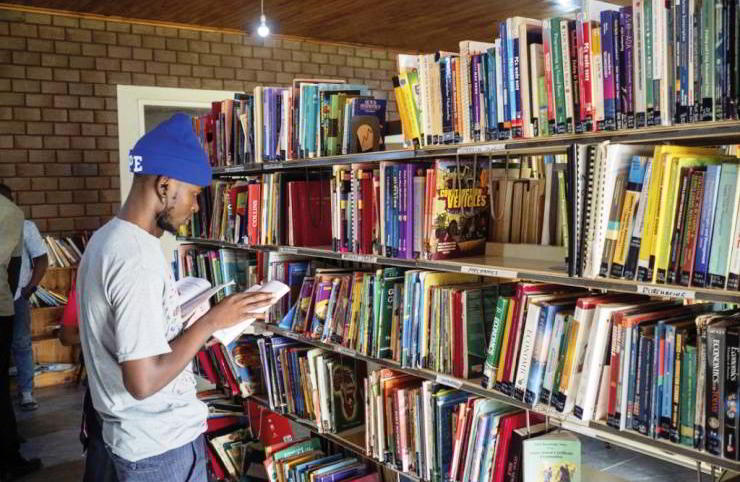
In addition to its social research programs, the CfSC houses a library open to the public – the second largest in the capital. Adjacent to the library is a computer lab where young people go to learn how to use computers proficiently. These community spaces provide students with access to information, resources, services, and education.
However, one of the Centre’s major challenges is a lack of funding. The CfSC “receives no state support,” the director emphasises, adding: “This is often the case because accepting state aid puts the Centre’s independence at risk.” For this reason, the institution collaborates with organisations such as the German development agency Deutsche Gesellschaft für Internationale Zusammenarbeit (GIZ) and Trócaire – the official development agency of the Irish Catholic Church – among others.
The CfSC’s dream is to expand its network of donors, including at the local level, to ensure the sustainability of its programs, safeguard its independence, and strengthen its capacity to influence social policies. (Boniface Gbama) – (Photo: Gonzalo Vitón)