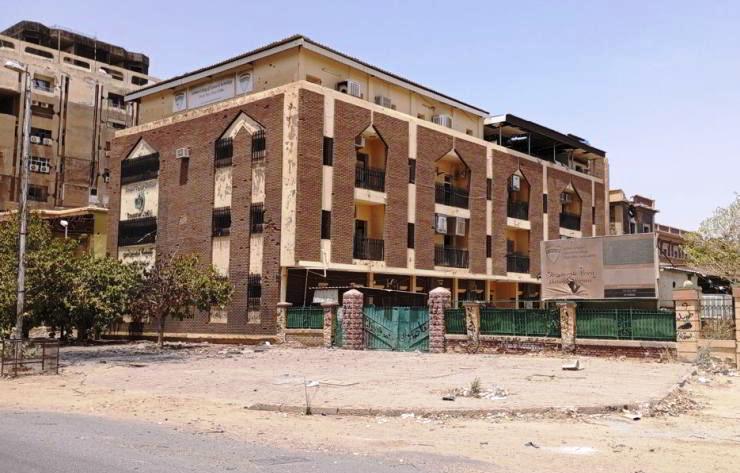
Amid the ongoing war in Sudan, the Comboni Missionaries continue their work of educating young people, knowing that this way they can dream of a better future for the East African country.
Ahlam was 18 when she left her home in the Nuba Mountains in southwest Sudan to study nursing at the Comboni College of Science and Technology (CCST), the university founded by the Comboni Missionaries in Khartoum, the country’s capital. It was June 2022, and she approached the adventure with enthusiasm and a desire to serve her community as a nurse.
On April 15, 2023, war broke out between the Sudan Armed Forces (SAF) and the Rapid Support Forces (RSF), a powerful militia with over 100,000 soldiers attempting to seize power. Khartoum became a fierce battlefield, and Ahlam, her colleagues, the CCST staff, and nearly all the missionaries fled for their lives.
The war between the SAF and the RSF, which has since spread to other regions of Sudan, has left over 11 million internally displaced persons, 4 million refugees, and 21 million malnourished. It has forced 10 million children out of school, and 87% of university students have been obliged to abandon their studies. Ahlam took refuge in Kadugli, her hometown, in the state of Kordofan.
In January 2024, the CCST resumed its activities in the digital world from Port Sudan, a city located on the Red Sea. The Comboni Missionaries ran the parish and a secondary school which, due to the influx of displaced people, now had 900 pupils. They also ran four nearby primary schools where people displaced by the war had settled. These schools have 2,500 pupils.
The CCST has undergone a rapid digital transformation to offer students and teachers, dispersed by the war throughout the country and abroad, the opportunity to continue their academic studies. This alternative is a light at the end of the tunnel and a glimmer of hope amid the barbarity of a war that has lasted almost three years.
The nursing course, however, requires practical lessons, first in the nursing laboratory and then in health facilities. The CCST signed an agreement with the Ministry of Health of the Red Sea State, and nursing students travel to Port Sudan at the end of each semester for their internships.
In August 2025, Ahlam was scheduled to leave Kadugli for Port Sudan. However, the city had been surrounded by the Sudan People’s Liberation Army-North (SPLA-N), a militia allied with the RSF.
She was determined to do everything she could to continue her studies, so she left with just a few bags and a cell phone, which she used to make calls and payments.
She walked and took buses in shifts to avoid SPLA-N checkpoints. After escaping them by sleeping in the courtyards of schools serving as shelters for displaced people, she arrived in the RSF-controlled area, known for its violence. She was arrested and locked in a room. She thought they were going to rape her. But she defended herself, offering some information in exchange for permission to continue her journey.
She finally arrived in El Obeid, 300 kilometres north of Kadugli, the first city under SAF control. She was finally able to openly say that she was going to Port Sudan, more than 1,000 kilometres to the north, to continue her studies.
Ahlam arrived in November. She had missed her clinical internship, but continued her studies and training to serve a community suffering from the violence of war.
In December, the Comboni Missionaries returned to Khartoum. The challenges they encountered were immense due to the destruction caused by the war in parishes and schools. The CCST needs significant investment to welcome and retrain the thousands of young people who once attended it.
(Photo. The Comboni College in Khartoum Today).