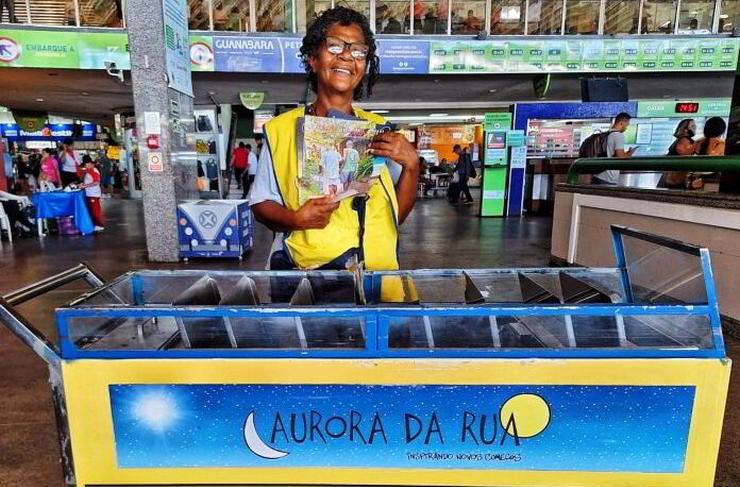
A magazine that promotes the voice, dignity, and talents of the vulnerable. A Lay Comboni Missionary who is part of the editorial staff shares her experience.
This newspaper, Aurora da Rua, was founded in 2007 by the Comunidad da Trindade, a community in Salvador de Bahia (Brazil) that welcomes people living on the streets and experiencing social vulnerability, excluded and marginalised by society.
From them, the idea of creating a newspaper was born, in response to the need to construct more human narratives, to combat stereotypes, and to valorise people who are often silenced and rendered invisible, promoting dialogue and awareness of social, cultural, and human rights issues.
In 2017, the newspaper transformed into a “magazine,” a publication officially launched by the Cultural Centre of the Municipal Chamber of Salvador, thereby expanding its readership.
Aurora da Rua also stands as a significant example of community communication and popular education, as it is produced with the direct involvement of the newspaper’s distributors and retailers—people who have left the streets or are in situations of social vulnerability. They all participate in the production, editing, and distribution. They not only sell the magazine but also contribute to its content through writing.
The magazine is therefore a tool for social participation, citizenship education, and cultural production, as well as for producing narratives that challenge the stigma surrounding people living on the streets.
In 2024, the magazine reached its 100th issue, a significant milestone that highlights its longevity and editorial consistency. The published articles address social, cultural, and basic human rights issues, focusing on the experiences of people still living on the streets and those who have left them, and offering broader reflections on society, exclusion, and citizenship.
The magazine is not only a tool for denunciation but also for building identity, self-esteem, transformation, and social reintegration. Its 19-year history demonstrates the resilience of this project, which is considered a benchmark for independent journalism in El Salvador, giving voice to those who generally have no way to make themselves heard.
Aurora da Rua is sold on the streets, in public squares, outside churches, and in bus stations. In a city like Salvador, with its social inequalities. Aurora da Rua goes beyond the media: it signifies citizenship, visibility, and resistance, showcasing the dignity, creativity, dreams, and humanity of street people.
I participate as a volunteer photographer and am very proud of this magazine because I know the people who are part of it; I see the commitment and passion in the construction of each theme and in the work of vendors like Lazzaro, who lives in the Comunidad da Trindade after many years spent on the streets, humiliated, abandoned, and rejected by his own family. Now, after a journey of rebirth, he has his own small home within the community and a small income from the sale of the magazine, a source of pride for him, as for many others, like Elisangela, a single mother with a son, who also lives in the Comunidad da Trindade, and Ailmar, who, after several relapses into alcohol, found in the community and the magazine a project from which to start over and be reborn. Their humanity is expressed in the magazine; it is told, made visible, and no longer hidden.
The Aurora da Rua team is primarily managed by a professional journalist, who helps with the writing; a graphic designer, who organises the distribution of content and photos; and, finally, many volunteers, who lend a hand with photographs, articles, contacts, and other initiatives.
Aurora da Rua truly transforms life on the streets of Salvador into words, art, and resistance. It is a magazine that illuminates, with humanity, the lives and struggles of people living on the streets, transforming survival into social poetry. (Emma Chiolini) – (Photo: Tamires Patriota)