The Wagenya fishermen, custodians of an ancient art, brave the turbulent waters of the great Tshopo River on fragile wooden tripods. But the real danger comes from elsewhere: intensive fishing, declining tourism, and internal strife threaten a community already struggling with precarious conditions.
The calm of the great river is abruptly interrupted near Kisangani, the capital of Tshopo Province, in the north-central part of the Democratic Republic of the Congo. The Boyoma Falls, formerly known as Stanley Falls, unleash their full power in a series of rapids that wind along the Lualaba River, precisely where it becomes the Congo, between the cities of Ubundu and Kisangani.
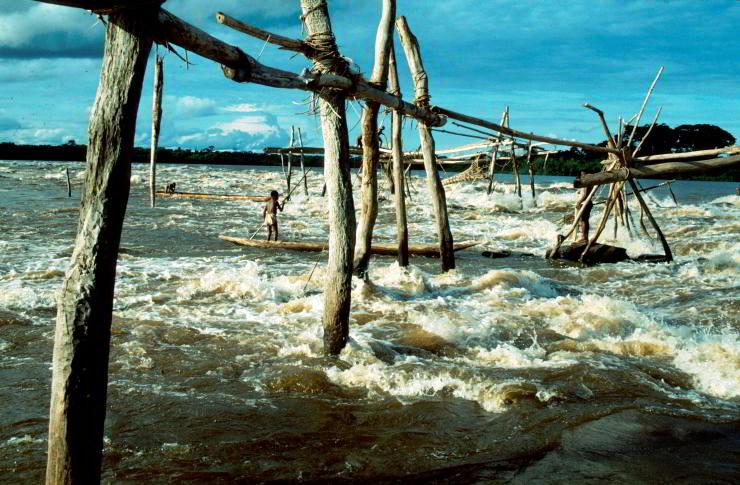
Amid the roar and the foam rising from the water crashing onto the rocks protruding from the riverbed, something almost impossible appears: wooden tripods upon which a large number of busy young men move casually. They are the Wagenya fishermen, undisputed masters of river fishing, an art rooted in ancient history.
The scene is, in fact, the same one encountered by Henry Morton Stanley, the British explorer who, upon arriving there in 1877, described the Wagenyans’ fishing method as follows: “They climb over the rapids on tolimos and use wooden baskets to catch the fish.”
One hundred and fifty years later, nothing has changed: the Wagenyans continue to build wooden tripods (tolimos) themselves, installing them directly above the rapids they call “Wagenya Falls,” just as their ancestors did.
These basic, yet sturdy, structures are constructed from natural materials, such as logs and branches collected from the surrounding forest. Suspended above the turbulent waters, the tripods act as platforms from which special baskets are lowered. The traps, similar to large funnel-shaped traps, are made of bamboo and secured with strips of bark. Strategically placed at the strongest points of the current, they harness the power of the water to trap fish swimming in the wide openings of the baskets, but the conical shape forces them into a cul-de-sac from which they will be unable to escape.
The ideal time to build and use these structures is the dry season, when water levels are low, and rapids are more accessible. During this period, the Wagenya work together to position the structures optimally along the river. At night, they guard the “traps” against fishermen from the opposite side of the river. Once caught, the fish are often brought to shore by the mouth, a symbolic gesture that highlights the fisherman’s skill and intimacy with the environment.
The catch is then shared among families or sold at local markets, serving as an essential source of protein for the community. This fishing method is the life of an entire community. Beyond providing food and income, fishing is a collective and inclusive art for the Wagenya. Men build the tripods and supervise the baskets.
Women dedicate themselves to harvesting, cleaning, and preparing the fish, often cooking it on banana leaves with palm oil and spices. Children learn from an early age to observe and participate, helping their parents.
Over the decades, generations of fishermen have tamed Africa’s second-longest river, the world’s second-largest by volume, transforming challenges into opportunities. Fishing remains a vital economic resource in the DRC. However, skill and perseverance are now being severely tested by unprecedented hardships.
Once the economic and cultural foundation of the Wagenyan community, basket fishing is declining due to increasingly intense fishing practices, harmful methods such as the use of mosquito nets to catch juvenile fish, and fishing during the spawning season. As a result, fish stocks have collapsed. Moreover, the lack of infrastructure and subsidies worsens the situation. “There used to be tripods everywhere; now there’s hardly any,” says a community fisherman. “The government used to subsidise the maintenance of the structures, but stopped over a decade ago, leaving fishermen to face the difficulties alone,” he adds.
Adding to the problem is the absence of strong leadership. The traditional chief’s position, a key figure representing the Wagenya community in government, has been vacant for over two years due to clan infighting, which has prevented the election of a leader capable of defending the community’s rights and addressing increasing economic and social hardships. This power vacuum has left the population without leadership, contributing to the build-up of social and economic issues.
Tourism, which could represent an alternative source of income, is also in decline. Small local businesses have previously attempted to launch ecotourism projects based on traditional fishing or guided rapids tours. These represented an opportunity to support the community and enhance the local cultural heritage, but the country’s chronic instability and logistical challenges have never allowed tourism to take off.
Furthermore, the COVID-19 pandemic has further reduced visitor numbers, depriving the community of a valuable economic resource. Some fishermen turned to agriculture in areas bordering the Congo River, cultivating corn, cassava, and other crops for their own consumption and for sale. Others started small businesses, selling essential goods at local markets or running food stalls.
Some also found occasional work as bricklayers, labourers, or transporters in nearby towns, such as Kisangani. These activities are far removed from the culture of these fishermen and, more importantly, unprofitable. Despite these difficulties, the Wagenya continue to struggle to preserve their traditions. (Valentina Giulia Milani/Africa) – (Photo: Swm)