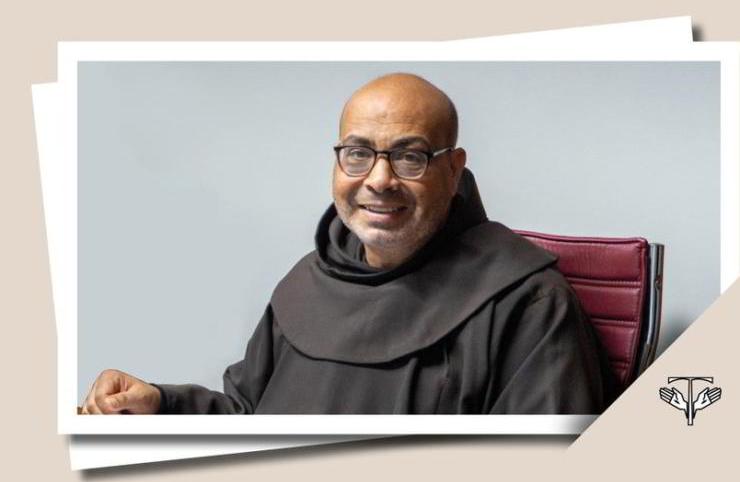
The majority of the Christian community comes from sub-Saharan Africa and Asia. Despite a context marked by political instability and social fragility, the Church manages to maintain its role as a point of reference, offering support to the most vulnerable and building bridges of dialogue between different cultures and religions. We spoke with Father Magdy Helmy, Apostolic Administrator of Tripoli.
Facing it is the Mediterranean, which unites Africa and Europe; behind it lies the desert that connects the North to the sub-Saharan region. Tripoli has always been a bridge city, a meeting place for different cultures and faiths. Here lies an ancient Catholic Church, small in numbers but constant, humble, and discreet, close to all, especially the poorest.
“The Christian presence is rooted in history,” explains Father Magdy Helmy, an Egyptian apostolic administrator of Tripoli, with extensive experience in the Maghreb. “According to Coptic Church tradition, Saint Mark was originally from Cyrene and converted many of his fellow citizens before founding the Church of Alexandria in Egypt.”
The Christian tradition has never died out, not even after the country’s Islamization. In 1645, with the permission of the Sultan of Constantinople, the Basilica of Our Lady of the Angels was built in the medina of Tripoli. A few years earlier, in 1630, the Holy See had established the apostolic prefecture of Tripoli, which became the apostolic vicariate of Libya at the end of the 19th century.
With the Italian conquest of Libya and the emigration policy implemented by the Fascist government, the number of Catholics in the country increased considerably. But after the Second World War and the expulsion of Italians, the face of the Church changed. “Monsignor Giovanni Innocenzo Martinelli, who led the Tripoli Church for years, said that ours is an Afro-Asiatic Church,” recalls Father Helmy. “Our faithful come mainly from sub-Saharan Africa and Asia. The Europeans, almost all diplomats or workers for large companies, are now a small minority.”
There are no official estimates of the Catholic presence in Libya, but it is estimated that there are approximately 18,500 faithfuls, with 16,200 in Tripolitania and 2,500 in Cyrenaica. The figure rises to approximately 100,000 when all Christians, including Reformed and Orthodox, are considered. “In Libya,” explains Father Magdy Helmy, “the Catholic presence is organised into two apostolic vicariates entrusted to the Franciscan Friars Minor: Tripoli and Benghazi. The former covers the western part of the country, from the Tunisian border to Sirte, encompassing the historic regions of Tripolitania and Fezzan. “
“The Benghazi vicariate, on the other hand, encompasses the entire eastern region of Cyrenaica, a vast and densely populated area that has played a strategic and cultural role in the country’s history for centuries. Two Franciscan priests and eight Missionaries of Charity (Sisters of Mother Teresa of Calcutta) work in Tripolitania. In Cyrenaica, the presence is reduced to two friars.”
Who are the faithful? They are all foreigners: Africans (Nigerians, Ghanaians, South Sudanese, Congolese, Ethiopians, Eritreans, etc.) and Asians (Filipinos, Pakistanis, Indians, etc.). “The doors of our churches are open to all,” continues Father Magdy Helmy, “Catholics come, but we also often host Reformed, Orthodox, and Anglicans. They come to pray and ask for a blessing. We don’t turn anyone away; on the contrary, we welcome them with pleasure and a fraternal spirit.”
In the church in Tripoli, religious services aren’t the only things celebrated. Communities gather to reflect on the word of God and share their traditions. “After Mass, which we celebrate on Fridays and Saturdays, there are many activities,” observes Father Helmy. “It’s beautiful to see the communities meditating on the Gospel, as well as reviving songs, dances, and convivial moments typical of their cultures.”
The Catholic Church operates in a complex context, marked by internal conflicts and a predominantly Muslim society. Despite this, the presence of the Franciscan friars is characterised by continuity and stability, with a mission that combines the spiritual and the social. “In addition to Masses and pastoral care for the faithful,” he observes, “the vicariate has set up a medical dispensary that offers free care and distributes medicines to anyone in need.“
“All services are offered without religious, ethnic, or linguistic distinction: Christians, Muslims, and members of other communities receive the same care, according to the fundamental principle of love of neighbour. We pay special attention to those who have left their homeland in the hope of reaching Europe.”
The friars also provide food and clothing to the poorest people. “We help for the love of God,” continues Father Magdy Helmy, “because every person deserves assistance and respect. This philosophy of openness helps build positive relationships with the local, predominantly Muslim, communities and ensures a climate of collaboration and mutual respect. We have good relations with the Muslims who live around us: we respect each other and the local rules. This allows us to work peacefully and help those in need.
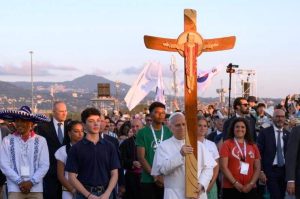
Even in complex contexts such as Libya, characterised by political instability and social fragility, the Church manages to maintain a role as a point of reference, offering support to the most vulnerable and building bridges of dialogue between different cultures and religions. “The Libyan mission,” he concludes, “is an example of how religion can become a concrete instrument of aid and peace, promoting universal values of acceptance, respect, and love for others, regardless of ethnicity, religion, or origin.” (Photo: Father Magdy Helmy, Apostolic Administrator of Tripoli).