African traditional healthcare systems use medicinal plants. They are among the oldest and most diverse systems of healthcare, and they remain the most accessible and affordable health resource.
One such highly valued medicinal plant is Sarcocephalus latifolius (Smith), the African peach, which belongs to the plant family Rubiaceae. The generic name of this plant is derived from two Greek words: sarco (fleshy) and cephalus (headed), in reference to the shape of the flowers.
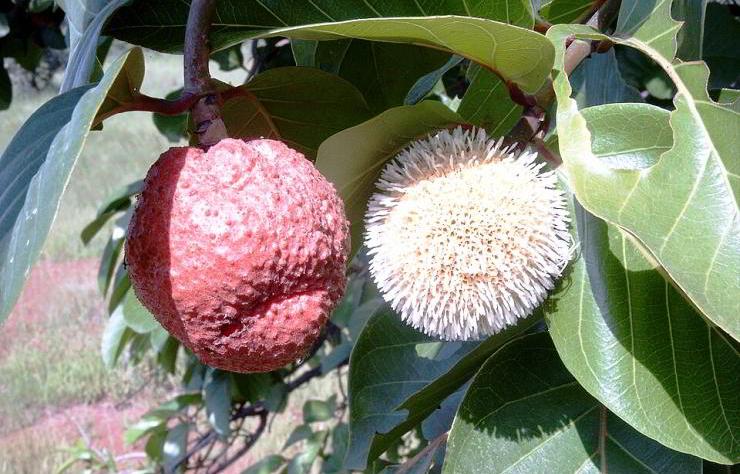
It is a savannah tree or shrub up to 12 m high, with a twisted trunk up to 30 cm in diameter and a spreading, multi-stemmed, open canopy. The stem is cracked and dark grey-brown, with a fibrous reddish slash. The leaves are shiny, dark green on the upper surface and paler below; they are broadly oval. The flowers form a terminal spherical head resembling a cyme. The fruit is a syncarp, round and red, and can be as large as an orange, containing many seeds embedded in its pinkish flesh.
Sarcocephalus latifolius is widely distributed in a number of African countries, including, but not limited to, Uganda, Cameroon, Congo, Gabon, Zaire, Benin, Côte d’Ivoire, Gambia, Ghana, Guinea, Guinea-Bissau, Liberia, Mali, Nigeria, Senegal, Sierra Leone and Togo.
The use of this Rubiaceae species in traditional African medicine for a given disease condition varies from one setting to another. All parts of Sarcocephalus latifolius have been used in one way or another for particular health conditions within different communities. However, the effectiveness of any part depends greatly on the season and time of harvest. For instance, the most effective roots for treating diseases are mostly harvested during the dry season in the evening, while the most effective leaves are also mostly harvested during the dry season but in the morning.
Preparations of Sarcocephalus latifolius herbal remedies can be made as a decoction or an infusion. The plant can also be ground into powder, mixed with soup or milk, and then drunk. In some cases, the juice or sap from plant parts is extracted by pounding or by the patient chewing them directly.
The leaf decoction of Sarcocephalus latifolius is used by traditional healers as a remedy for diabetes, malarial fever, constipation and pyomyositis. On the coast of West Africa, patients suffering from diarrhoea and dysentery are treated by eating the leaves of Sarcocephalus latifolius together with malagueta pepper, followed by a drink of warm water.
In addition, the leaf decoction is mixed with honey and taken as a beverage to cure abdominal discomfort or indigestion. In some instances, leaf juice extract is boiled in water and the resulting infusion is rubbed on affected areas of skin to treat rashes and body swellings.
The bark decoction is useful in the treatment of wounds, jaundice, cough and gonorrhoea, and is also prescribed as a mouthwash. In a number of communities, a cold infusion from the stem bark is used to regularise bowel function, treat common digestive problems and relieve a bad taste caused by indigestion.
The tree bark of Sarcocephalus latifolius is chewed as an antiseptic for mouth disorders and to treat mouth abscesses. A bitter yellow cold infusion prepared from the bark, once known as “African quinine”, is used as a febrifuge, a tonic and an anthelmintic remedy. The deep yellow stem bark extract is also used to dye skins and hides in some countries. Finely pulverised bark is applied to help heal wounds.
The root of Sarcocephalus latifolius is used in the treatment of venereal diseases and wounds. Root decoction preparations are used as anticonvulsants, anxiolytics, antihypertensives and laxatives. Root-powder decoctions are also used to treat hernia and gonorrhoea. Traditional healers administer the root infusion as a treatment for premature ejaculation in men.
In West Africa, the bitter root is administered to treat digestive disorders. Paste made from the roots is applied to treat skin rashes. A decoction made either from the whole root or from the macerated soft centre is taken to relieve indigestion. In addition, as with the stem bark, the root decoction is also used as a febrifuge and tonic. A mixture of root and stem bark decoction is administered as a purgative and to induce vomiting.
Apart from its medicinal properties, the edible fruits are gathered from the wild—especially by children—for local use, and are often sold in local markets. The fruits, eaten in many communities, have an acidic taste and the aroma of peaches. They can be eaten fresh or dried. The fruits are also eaten as a remedy for coughs. Sarcocephalus latifolius is additionally a source of food, domestic fuel and timber for building.
The healing ability of Sarcocephalus latifolius has made it attractive in African herbal markets, and its wide use suggests that this medicinal plant plays a significant role in traditional healthcare delivery in many communities. It will most likely continue to play a vital role in healthcare systems for generations to come. (Komakech Richard and Omujal Francis) – (CC-BY-SA 3.0/Marco Schmidt)