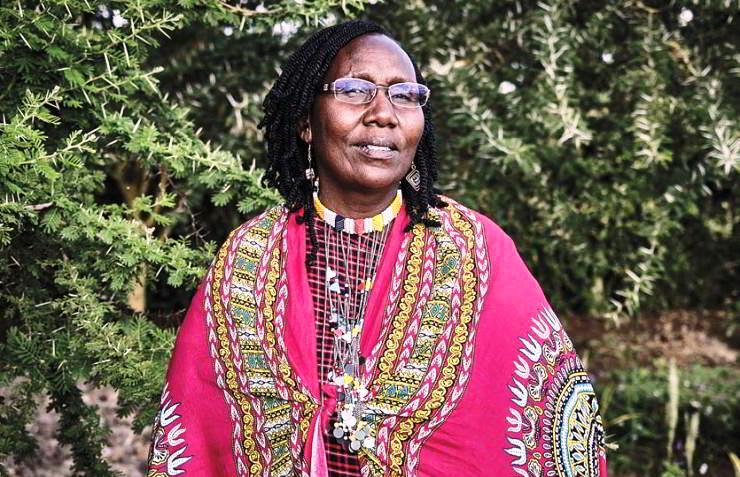
Maanda Ngoitiko founded the Council of Women Shepherds (PWC) alongside ten other Maasai women. The organisation’s focus is on defending the rights of women and girls within their community, to change gender roles within a traditionally patriarchal society.
“I am the daughter of a Maasai herder family from Olosirua, Kenya. My name comes from the mountains. My mother walked for five days to get to the hospital, but when she could no longer do it, she gave birth at the foot of a mountain called Parmaanda. That’s how my name was chosen. I have nine siblings, four girls and five boys. I am a Maasai woman, a herder, and a mother who, in 1992, decided to take a step forward for all of us. So, with other Maasai women, in 1997, I founded the Women Pastoralists’ Council (PWC),” Maanda tells us with a calm voice and a proud look.
She continues: “The root of this commitment lies in my personal history. As a child, my life was controlled by my family and clan. Maasai culture is very patriarchal, and the tribe defines every role and responsibility, especially when a child is born. At the age of nine, I was selected to attend school. At the time, there were only two girls in my village who attended school.”
“My only friend was forced to marry at 14, and I witnessed her suffering because she didn’t want to get married. She managed to escape, but a group of men came to catch her in the nearby village where she had been hiding. On the way back, they continued to beat her, and even after they arrived. I felt helpless because I couldn’t help her, and above all, I was frustrated because I knew that one day it would be my turn. It was a very difficult time. I needed help, but no one could lend me a hand.”
But at 14, Maanda’s life changed. Her mother and the women of the community told her she had to drop out of school, undergo the rite of passage of female genital mutilation, and prepare for marriage. Maanda, however, refused: she didn’t want to become the third wife of a much older man who wouldn’t make her happy.
Maanda recalls: “At that time, the 1990s, the political sphere was starting to take an interest in issues like child marriage, and I was lucky because a member of Parliament heard my story and decided to support me with a scholarship. My family opposed it, but I ran away during the night and didn’t look back for two years. I trained in sustainable development and studied environmental science at the University of Nairobi, and when I returned, I founded the Council of Women Shepherds (PWC).”
The Council of Women Shepherds’ goal was very ambitious: to create a new generation of Maasai women who could make decisions and have their own voice, endowed with dignity, freedom, and rights. Maanda explains: “We started in 1997 as a forum where we openly discussed issues related to education, family finances, and rites of passage, to create a strong network of committed women. Our goal was always to educate girls and prevent their families from marrying them off. We often found ourselves in situations where the man had already paid a dowry to the family.”
“When everything was ready for the wedding, the PWC appeared, and in collaboration with the authorities, we managed to rescue many girls and take them to a safe place, which on many occasions was my home. Initially, however, the men were wary. Since it was the first time the women had seriously organised themselves, the husbands and leaders told us, “You must tell us exactly what you will do before talking to our women,” or “There must be only men on the board of directors.”
Since we knew this would happen, we were prepared. We never wanted to replace men, but to promote equality: “If a boy can go to school and become a teacher, we can too; if he can have land in his name, then I, as a woman, can too.” This, as expected, caused tensions. Maanda remembers when they appeared before a traditional leader who wielded considerable power and whom no one dared to contradict.
She says, “Not only did he refuse to meet with us, but he insulted and humiliated us because he thought we wanted to revoke the power of men. Later, we presented a project that challenges the philosophy that Maasai women cannot own cattle, even if we raise them. We wanted to have our own [traditional Maasai compound] boma and our own land where we can control and sell our cattle, something that had never happened before. That leader strongly opposed it and said that “only when we have money can we make decisions.”
However, one day something happened that changed the chief’s mind. In 2022, dozens of police and army vehicles arrived in Pololeti, an area of Loliondo in northern Tanzania, to forcibly evict the Maasai from their land and establish a hunting reserve. It was the Maasai women who protested energetically. They protested for five days. This gave the Maasai women a lot of credibility because they had seen them fight.
Speaking about their commitment, the Council of Women Shepherds (PWC) says: “For 10 years, we have been working exclusively on girls’ education, creating school committees and parents’ associations, mobilising communities to build schools, and establishing links between local administrations and education departments. This has been very positive because it has fostered trust between the community and local governments. Then we expanded our scope and created VICOBA, a project that teaches women community-level microfinance techniques to support one another financially and manage their businesses.”
“These [monthly] meetings go beyond money because they create spaces to discuss leadership, investments, domestic violence, and family issues that arise with polygamy. We also organise leadership and women’s rights forums, where we train women to occupy positions of power at the political level. With this, we create the pyramid of power.”
“What is achieved in this way, and cannot otherwise be achieved, is that the rights of the Maasai are respected. Finally, we have created an atmosphere of solidarity to make it easier for women to own property and livestock in their own names. We don’t want to take power from men, but make decisions together. This creates a more equal society. If we decide together, we’re all happier.”
One of the significant results has been the change among men. Maanda emphasises, “We now have more than 20 men working to save girls who are forced into marriage and bring them to safe spaces. Furthermore, we’ve also noticed that the relationship between husband and wife has improved with the microfinance project. Nevertheless, there are still challenges. Elders believe these activities undermine the foundations of Maasai culture. I believe it’s a very important discussion. Being women allows us to witness the change we want to see.”
And finally, she concludes: “I don’t separate my life from my commitment to my community. I know girls who have been through indescribable situations and women who suffer daily, and I know I want from the bottom of my heart to change that. I want to see a new generation of Maasai women who have the right to make decisions and have a happy life.” (Text & Photo: Diego Mrnjíbar)